wheel-reviews 11 min read
Used Pottery Wheel Buying Guide: Check This Before You Pay
What to check on a used pottery wheel: motor and pedal, bearing wear from splash-pan overflow, parts availability by brand, and fair price bands by model.

A used pottery wheel in working order is worth roughly 40 to 50 percent of current new price, and Speedball’s refurbished pricing sits in that band. Test the pedal from a dead stop, listen to the bearings with the head off, and confirm the brand sells parts. Splash-pan overflow damage is the fault worth walking away from.
That first sentence is not a guess. Speedball publishes both numbers on the same product page, which makes the used pottery wheel market one of the few secondhand markets with a manufacturer-set reference price sitting in plain sight.
What should a used pottery wheel cost?
Speedball sells its Boss series in two conditions from its own store, new and factory-inspected/used. Both prices are public, so the ratio between them is a published fact rather than an opinion.
| Speedball wheel | New | Factory-inspected used | Used as a share of new | Warranty on the used unit |
|---|---|---|---|---|
| Clay Boss | $1,399.00 | $630.00 | 45.0% | 1-year limited |
| Big Boss | $1,749.00 | $699.00 | 40.0% | 1-year limited |
| Boss Elite | $1,999.00 | $799.00 | 40.0% | 1-year limited |
Prices read from speedballart.com on 1 August 2026. New wheels carry Speedball’s 10-year warranty plus a $50 rebate; the factory-inspected units carry a 1-year limited warranty.
Forty to forty-five percent, set by the manufacturer, on a wheel that has been through their own bench and carries a year of coverage. That is the number a private seller has to beat, and it produces the single most useful rule on this page: a private-party Clay Boss priced above $630 is a bad deal, because $630 buys the same wheel inspected and warranted. The same logic caps a used Big Boss at $699 and a used Boss Elite at $799.
For brands that do not sell refurbished units, the same ratio is a reasonable starting frame, and it lines up with what L&L publishes for used kilns: about half of comparable new in good condition. Against AMACO’s current Brent MSRPs, read live on 1 August 2026, that produces the following bands.
| Wheel | New MSRP | Motor | Rated capacity | Working-order band at 40 to 50% |
|---|---|---|---|---|
| Brent Model B | $2,700 | 1/2 HP DC | 150 lb | $1,080 to $1,350 |
| Brent Model C | $2,800 | 3/4 HP DC | 225 lb | $1,120 to $1,400 |
| Brent Model CXC | $2,900 | 1 HP DC | 300 lb | $1,160 to $1,450 |
| Skutt Prodigy | $1,950 | 1/3 HP | 12-inch head | $780 to $975 |
| Skutt Classic | $2,700 | 1/3 HP | 14-inch head | $1,080 to $1,350 |
| Skutt Legend | $2,800 | 1/3 HP | 14-inch head | $1,120 to $1,400 |
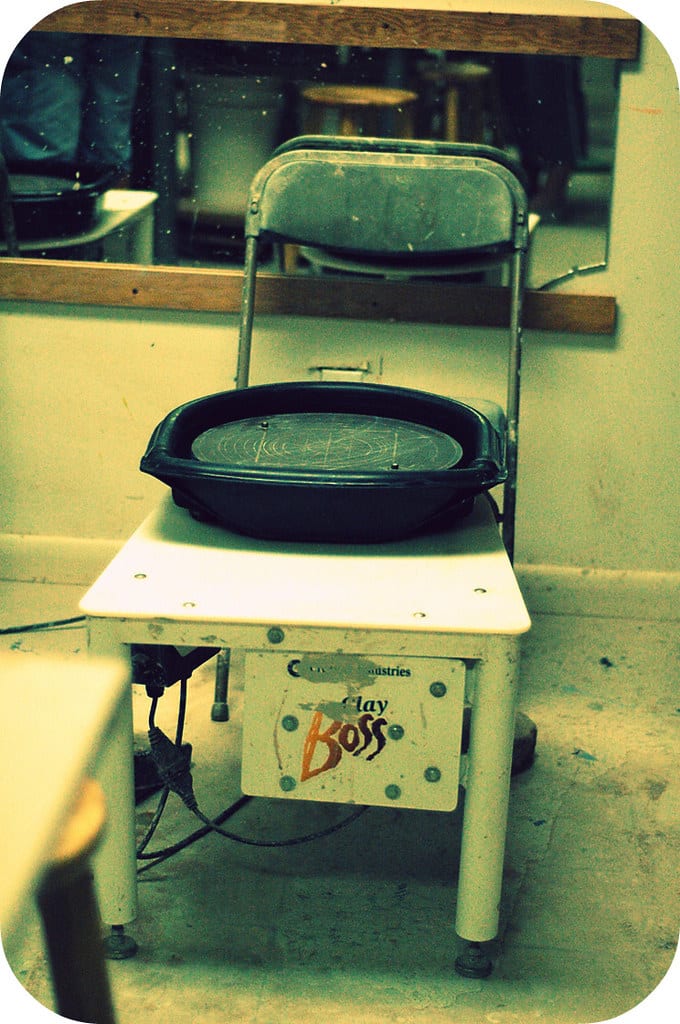
| Speedball Clay Boss | $1,399 | 1/2 HP belt | 100 lb | $560 to $630 |
New prices from AMACO’s own store and Skutt’s 2026 wheels price list effective 10 January 2026, both read 1 August 2026. Bands are the 40-to-50-percent range computed from those figures, using Speedball’s published refurbished ratio as the anchor. They are a negotiating position, not observed sale prices.
Two adjustments to make on the spot. Subtract the cost of any part that is obviously due, using the repair table further down. And add nothing for age alone: a Brent that has been throwing three pounds a day for fifteen years in a clean studio is worth more than a five-year-old wheel that lived under a leaking splash pan.
How do you test a used pottery wheel in ten minutes?
Plug it in and do these five things in order. Every one of them is diagnostic, and together they take less time than the drive.
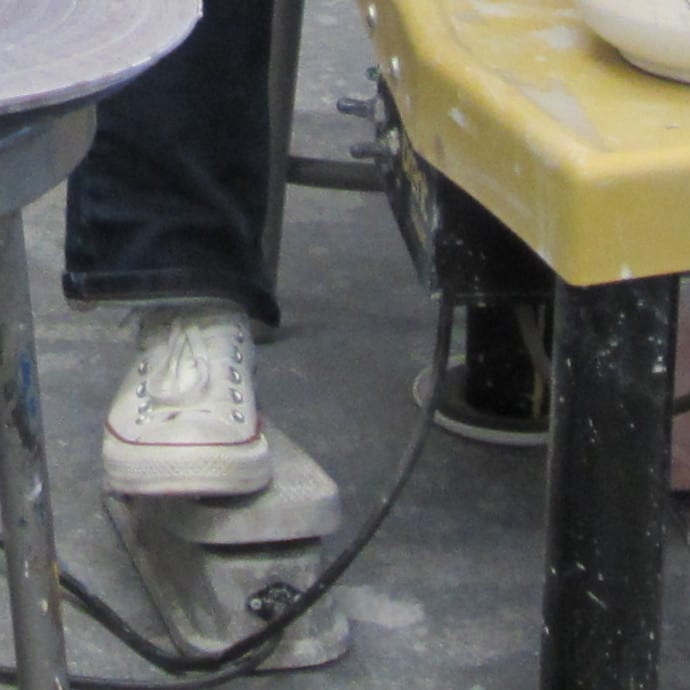
1. Run it up and down with no clay. The head should start from a dead stop smoothly and hold whatever speed you set it to. A wheel that jumps to life at a third of pedal travel, or that will not creep at the bottom of the range, has a pedal or controller fault rather than a motor fault. That distinction is a $46.80 repair kit against a $600 motor on a Brent, so it matters.
2. Load the head with your hand. Press down hard on the spinning head, off-center, and listen. A healthy DC wheel loses very little speed under hand pressure. A belt-drive wheel that slows dramatically and squeals has a glazed or slack belt, which is cheap. A wheel that slows and smells hot has a motor problem, which is not.
3. Reverse it. Most full-size wheels reverse. On Speedball’s Boss series the reversing procedure is documented: power off, unplug the motor cord at the connector, rotate it 180 degrees, plug it back in. On Brent wheels there is a forward and reverse toggle with a neutral safety position. If reverse does nothing, you have found a switch fault. The Artista does not reverse at all, by design, with direction chosen at purchase.
4. Take the head off and turn the shaft by hand. This is the check almost nobody performs and the one that finds the expensive fault. The shaft should turn smoothly with no grinding, no gravelly feel and no side-to-side play. Roughness here is bearing wear.
5. Look under the splash pan. Water pooled in the pan for years is the specific cause of bearing failure, and Shimpo says so in their own warranty terms: empty the splash pan frequently, because water flowing over the inside of the pan “can lead to damage to the motor bearings,” and overflow damage is not covered. Rust streaks running down from the pan onto the frame or the motor housing tell you exactly how the previous owner treated it.
What do the common faults cost to fix?
These are the manufacturers’ own list prices for the parts a used wheel typically needs, read live on 1 August 2026. The right-hand column is what the repair costs as a share of a new Brent Model C at $2,800, which is the fastest way to see whether a cheap wheel is actually cheap.
| Fault | Brent part and price (AMACO) | Skutt equivalent | Share of a new Model C |
|---|---|---|---|
| Slack, glazed or cracked drive belt | 6-groove flex belt for B, C, CXC: $55.00 | Drive belt: $25.00 | 2% |
| Worn motor brushes | Brushes for Model C: $57.40 (A and B: $38.50; CXC: $82.00) | not applicable, brushless | 2% |
| Pedal feels notchy or will not start smoothly | Foot pedal repair kit with pedal: $46.80 | Soft potentiometer: $52.00 | 2% |
| Pedal electrically dead | Foot pedal electrical assembly with cord: $171.00 | Foot pedal V2 replacement: $395.00 | 6% |
| Whole pedal replacement | Foot pedal complete assembly: $345.00 to $359.00 | Foot pedal V2: $395.00 | 12% |
| Speed control board failure | Foot pedal speed control subassembly: $115.00 | SSX2 replacement controller: $430.00 | 4% |
| Bearing rough or noisy | (bearing sold within the head assembly) | Five-bolt bearing block: $98.00 | 4% |
| Wheel head gouged, warped or seized on the shaft | 14-inch head subassembly: $385.00 | 14-inch wheel head: $330.00 | 14% |
| Splash pan cracked or missing | Deep removable splash pan: $195.00; Shimpo two-piece 19-inch pan: $69.00 | 7% | |
| Motor replacement | 3/4 HP 115V DC: $600.00 (1/2 HP $590.00, 1 HP $630.00 to $680.00) | 1/3 HP 90V DC: $365.00 | 21% |
Brent prices from AMACO’s parts catalogue, Skutt prices from the 2026 Skutt wheels price list effective 10 January 2026, Shimpo splash pan from the VL-Whisper accessory listing. All read 1 August 2026.
The pattern is worth reading twice. Belts, brushes and pedal repair kits are all under $60. A pedal, a controller or a bearing lands between $98 and $430. Only two faults are genuinely expensive: the motor and the wheel head. Add those two to a pedal and a belt on a Brent and you are at $1,385, which is 49 percent of a new Model C, and the used wheel has stopped making sense.
Motor brushes deserve a note of their own. Brent’s DC motors are brushed, so the brushes are a consumable, priced at $38.50 to $82.00 depending on model. A Brent that runs but sparks visibly at the motor or has become noticeably weaker is often a brush job rather than a motor job. Shimpo’s VL-Whisper runs a DC brushless motor, and its published parts list bears that out: there are no brushes on it anywhere, only a motor assembly, an encoder and a Hall sensor. One fewer consumable, one more thing that fails as an assembly rather than as a part.
Which brands still sell parts?
This is the question that decides whether a fifteen-year-old wheel is an asset or a paperweight.
Brent, through AMACO. The deepest parts support in the category. AMACO stocks Brent parts by category: belts, controller parts, cords, foot pedal parts, fuses, heads, knobs, motors, pulleys and miscellaneous hardware, all listed with prices on their own site. The Model C listing advertises “modular connections for motor and foot pedal,” which is a design decision that pays off on a twenty-year-old wheel. Brent is the safest used buy in the category for this reason alone. See the Brent Model C review for what the wheel is like new.
Skutt. Publishes a full wheel parts price list with part numbers and retail prices, from a $2.50 fuse to a $505 controller with box, alongside a bearing block at $98 and a 14-inch head at $330. Published prices are what let the Skutt column in the table above carry exact figures rather than estimates. Skutt’s list covers its electric wheel platform generally rather than one model, so a part number is worth checking against the wheel’s own serial tag before ordering.
NIDEC-SHIMPO. Publishes a complete parts list by part number for the VL-Whisper and its siblings, and maintains a directory of local repair people by state, which is unusual and genuinely useful. Pricing goes through dealers rather than being published. One warning sits in that parts list and it is important for used buyers: the old-style motor assembly, part ARKA3400110, is marked DISCONTINUED, with the new-style assembly ARKA3400112 as the current part. An older VL-Whisper whose motor has failed may not be repairable with a factory motor. Verify which motor generation a used Shimpo has before buying one that does not run. The Shimpo VL-Whisper review covers the current model.
Speedball. Sells wheels, pedals and accessories directly, including an Artista foot pedal at $154.26 and folding Artista legs at $335.50, and sells whole refurbished wheels as covered above. The Speedball Clay Boss review and Speedball Artista review cover both current models.
Everything else. Plenty of older Clay Boss and Big Boss wheels wear a Creative Industries badge rather than a Speedball one. The model names are the same ones Speedball sells today, but do not assume a current part fits an older badge: send Speedball the serial number and ask before you order. Kick wheels are a different proposition entirely. A kick wheel has almost nothing to fail, and a bare frame with a true flywheel and a sound bearing is worth buying at almost any price, because there is no motor, no controller and no pedal to go wrong. Unbranded imports with no maker’s name anywhere on the frame have no parts channel at all, and should be priced as though the motor and controller are single-use items.
What comes with the wheel, and what does not?
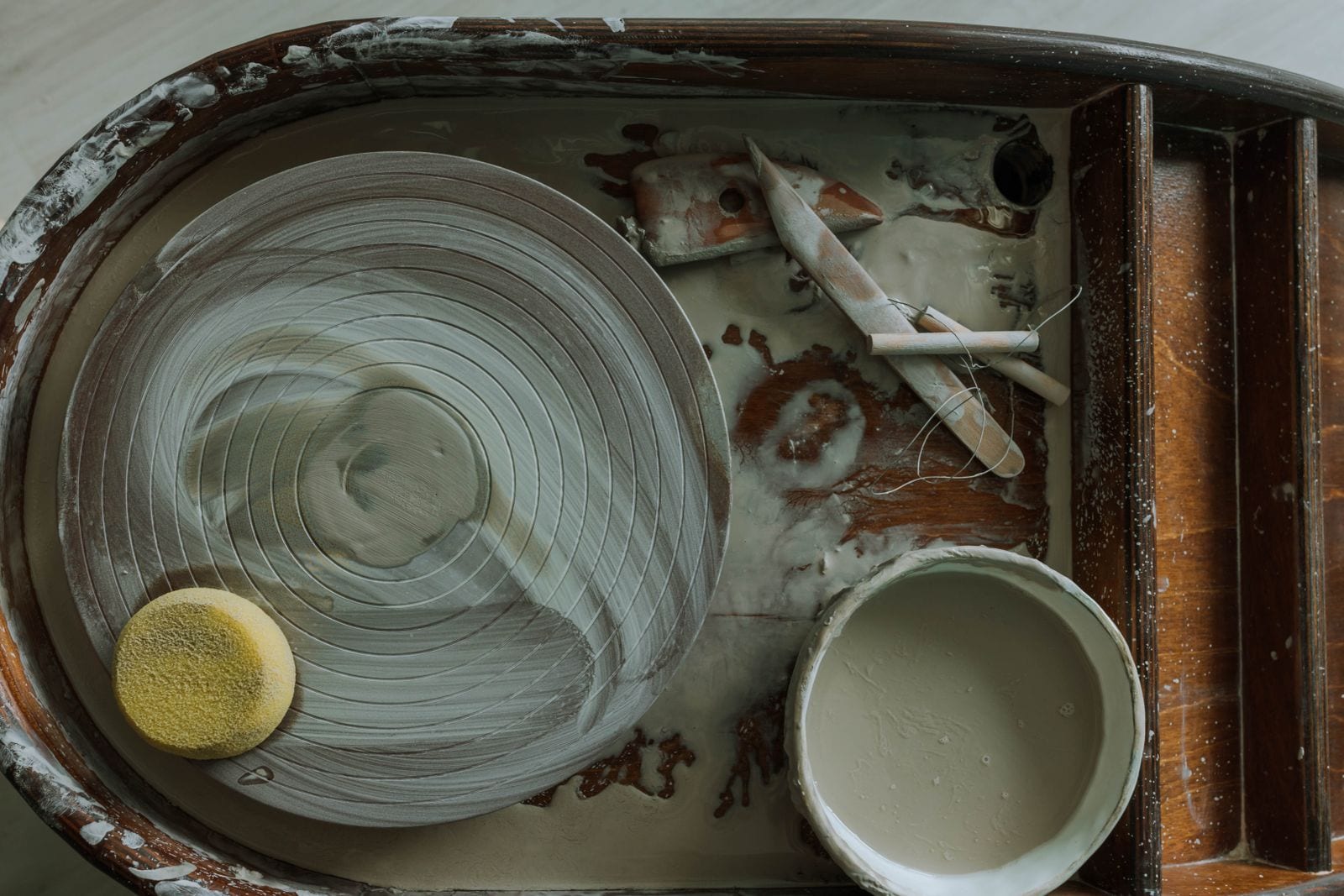
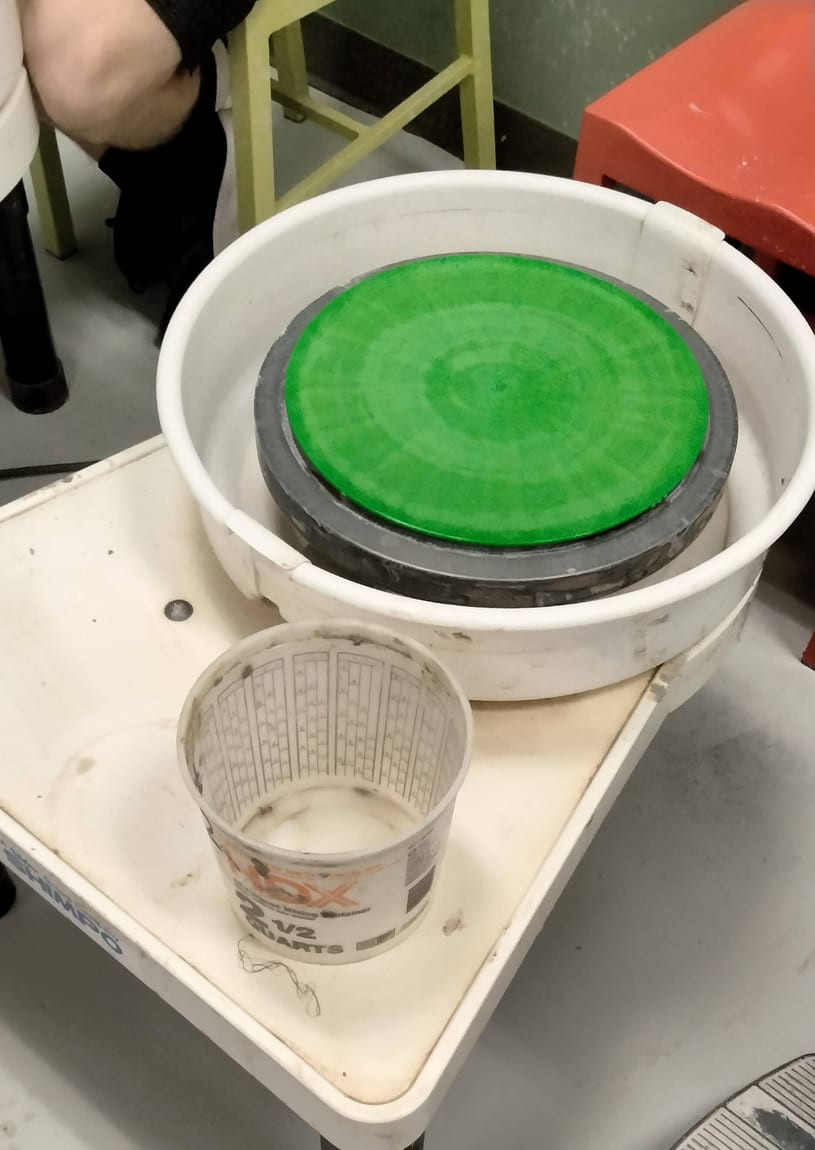
Bats, splash pan and stool are the three things sellers keep and buyers forget to ask about. New Brent wheels include a splash pan and a 14-inch Plast-i-Bat; the Boss series uses universal 10-inch bat pin spacing, so any bat cut for that pattern fits. A used wheel arriving with a stack of bats is worth $50 to $100 more than one that does not, and a used wheel arriving without a splash pan is worth $69 to $195 less, depending on brand.
Ask for the manual and any repair receipts. A receipt for a pedal rebuild three years ago is good news, not bad: it means the wear item was addressed and the owner cared. What you do not want to see is evidence of improvised repair. Shimpo excludes damage caused by unauthorized repairs from its warranty, and while that warranty is unlikely to survive to a second owner anyway, a wheel with a rewired pedal and a hardware-store switch has been apart in the hands of someone guessing.
Where a used wheel beats new, and where it does not
Used wins decisively on frames. A Brent’s all-steel table, powder-coated legs, cast aluminum head and 6-groove drive are built to a standard that has not changed in decades, and none of it wears out in a home studio. Buying that structure secondhand and putting $100 of consumables through it is the best value in the craft.
Used loses on two things. The first is warranty: Speedball’s split is 10 years new against 1 year on their own refurbished units, and a private sale carries nothing at all. The second is the unknown history that the price is supposed to compensate you for. A wheel that has spent its life under an overflowing pan looks identical to one that has not until you take the head off.
If you are choosing your first wheel and do not yet know what a worn bearing feels like, read the pottery wheel buying guide first and price the model you actually want new. Then come back with a number, and hold to it. For the belt-drive against direct-drive question that decides which used wheels you should even consider, see Brent Model C vs Shimpo VL Whisper and VL Whisper vs Clay Boss. For the current picks by buyer type, see best pottery wheels.
What to take with you
A meter, a bat, and the willingness to take the wheel head off in someone’s garage. As an Amazon Associate we earn from qualifying purchases.
- Klein Tools MM420 digital multimeter for continuity across the pedal cord, which separates a $46.80 repair kit from a $345 pedal assembly.
- An AMACO Plasti-Bat to test the bat pins actually hold, and because used wheels rarely come with bats.
- Pottery bats for 10-inch universal pin spacing if the seller keeps theirs.
- Throwing tool sets for the ribs, needle tools and wires that never come with a used wheel.