wheel-comparisons 10 min read
Speedball Clay Boss vs Artista: The Real Out-the-Door Gap
The Artista is $598 and the Clay Boss $1,120. Add the pedal and legs the Artista needs and the gap falls to $226. Verified August 2026 prices and specs.

Bare, the Speedball Artista costs $598 and the Clay Boss $1,120. But the Artista ships with a hand control and no legs, so a seated, pedal-driven Artista comes to $893.49 once you add both. The real gap between these two wheels is $226.50, and it buys four times the centering capacity, three more inches of head, and twice the warranty.
Speedball sells them as the entry model and the middle model of the same family. On the shelf that is true. In a working studio they are answers to different questions, and the specification that separates them most is not on the front of either box.
What is the actual out-the-door price?
Every comparison of these two wheels quotes $598 against $1,120 and stops. That comparison is wrong, because the two wheels are not sold in the same state of completeness.
The Clay Boss arrives as a floor wheel with a foot pedal. The Artista arrives as a tabletop wheel with a hand control, and a foot pedal and legs are separate purchases from Speedball’s own catalogue.
| Item | Speedball Artista | Speedball Clay Boss |
|---|---|---|
| Wheel, street price | $598.00 (Sheffield Pottery) | $1,119.99 (Soul Ceramics) |
| Speed control in the box | variable speed hand control | variable speed foot pedal |
| Foot pedal | $154.26, sold separately by Speedball | included |
| Legs for seated throwing | $141.23 static leg set (Sheffield) | included, it is a floor wheel |
| Two-part splash pan | included | included |
| Bats (7.5 in and 12 in) | included | included |
| Bat pins | included | included in the head |
| Buckets | two 2.5 qt included | not listed |
| Configured for seated, pedal-driven throwing | $893.49 | $1,119.99 |
| Difference | $226.50 |
Wheel prices are the lowest verified dealer selling price for each on 2 August 2026: Sheffield Pottery for the Artista, Soul Ceramics for the Clay Boss. Krueger Pottery lists the Clay Boss at $1,149.00 the same day, so read the gap as $226 to $256. The foot pedal price is Speedball’s own. The leg set price is Sheffield’s, and it was out of stock on the date read, so treat it as a configured price rather than a checkout price. At Speedball’s own list prices the same comparison is $1,044.49 against $1,399.00, a gap of $354.51.
Two hundred and twenty-six dollars. That is the number the decision actually turns on, and it is less than half of what the shelf prices suggest.
Does the hand control matter that much?
It matters more than any other line on either spec sheet, and it is the thing most beginners do not find out until the clay is spinning.
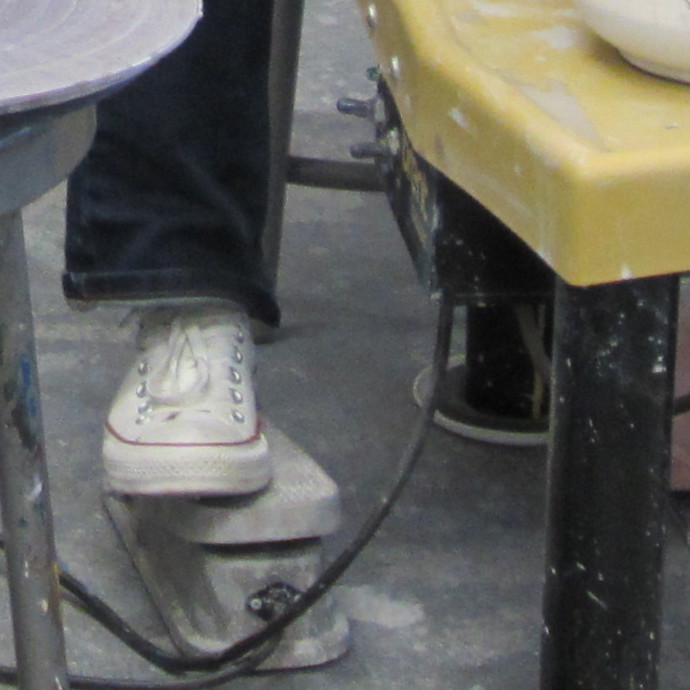
Throwing takes both hands. Centering takes both hands pressed hard against a moving mass, and the moment you need to slow down is precisely the moment neither hand can leave the clay. A foot pedal solves that; a hand control asks you to break contact with the pot to change speed.
There are people for whom the hand control is the right answer, and Speedball is not wrong to sell it. Handbuilders decorating on a slow turn. Teachers demonstrating. Throwers with limited lower-limb mobility, for whom a hand control is an accessibility feature rather than a compromise, and Sheffield’s listing specifically notes the Artista suits stand-up throwing and physically challenged access. Those are real use cases and the wheel serves them well.
For a beginner learning to centre, it is a handicap you will pay $154.26 to remove.
What does each wheel cost per unit of capability?
Here the two wheels swap positions depending on how you measure, which is why the argument never settles.
| Metric | Artista, configured | Clay Boss | Which is dearer |
|---|---|---|---|
| Price as configured for seated throwing | $893.49 | $1,119.99 | Clay Boss, by 25 percent |
| Centering capacity | 25 lb | 100 lb | |
| Dollars per pound of capacity | $35.74 | $11.20 | Artista, by 3.2x |
| Wheel head diameter | 11 in | 14 in | |
| Wheel head area | 95.0 sq in | 153.9 sq in | |
| Dollars per square inch of head, configured | $9.40 | $7.28 | Artista, by 29 percent |
| Dollars per square inch of head, bare wheel only | $6.29 | $7.28 | Clay Boss, by 16 percent |
| Motor | 1/3 HP | 1/2 HP | |
| Top speed | 220 rpm | 240 rpm | |
| Warranty | 5 years | 10 years | |
| Wheel weight | 26 lb | 68 lb |
Head areas computed from the published diameters as circles: 11 inches gives 95.0 square inches, 14 inches gives 153.9. Capacity and motor figures from Speedball’s own product pages. Prices as in the table above.
The bare-wheel row is the honest case for the Artista: at $598 for 95 square inches of head, it is cheaper per square inch than the Clay Boss. That is a genuine argument if a hand control suits you and you already own a bench.
Every other row goes the other way, and the capacity row goes there emphatically. You pay 3.2 times as much per pound of centering capacity on the Artista. Whether that is a bad deal depends entirely on whether you will ever use the capacity, which is the next question.
Is 25 pounds actually a limit you will hit?
Not in your first year, and possibly not ever.
A mug takes 1 to 1.5 pounds of clay. A cereal bowl takes 2 to 3. A dinner plate takes 4 to 5. A beginner throwing for a year rarely centres more than 5 pounds at once, and at those weights the Artista’s 1/3 HP motor runs without complaint.
The 25 pound figure is a load rating for the motor and bearings, not a target for a single throw. So is the Clay Boss’s 100. Almost nobody centres 100 pounds of clay on a Clay Boss either.
What the numbers really encode is headroom. A motor asked to hold 8 pounds against your hands when it is rated for 25 works differently from one rated for 100. Speedball says the Clay Boss carries load-sensing control that maintains head speed under a changing load, a claim it does not make for the Artista. That is the specification that describes what centering feels like: whether the wheel slows when you lean on it.
The other honest ceiling is not weight at all. It is diameter.
| Form | Clay needed | Fits an 11 in head? | Fits a 14 in head? |
|---|---|---|---|
| Mug, 3.5 in wide | 1 to 1.5 lb | yes, comfortably | yes |
| Cereal bowl, 6 in wide | 2 to 3 lb | yes | yes |
| Serving bowl, 9 in wide | 4 to 6 lb | at the limit | yes |
| Dinner plate, 10 to 11 in wide | 4 to 5 lb | no | yes |
| Platter, 13 in wide | 7 to 10 lb | no | at the limit |
A flat form needs wheel head under its rim while you open and spread it, so the practical ceiling on any head is roughly two to three inches under its diameter. This table applies that rule to common functional forms.
That is the constraint that actually retires an Artista. Not the motor giving up on 12 pounds of clay, but the day you want to make a set of dinner plates and there is no head left to work on.
The specification nobody mentions: handedness
The Artista is sold as a right-handed wheel or a left-handed wheel, and Speedball states plainly that the direction cannot be changed after purchase.
The Clay Boss has a reversing plug. Pull it, turn it, plug it back in, and the head runs the other way.
For a solo right-handed thrower this is nothing. For anyone else it is a real fork in the road:
- A left-handed beginner buying an Artista has to order the correct version, and a used one on the resale market is a coin flip.
- A household or a shared studio where two people throw with opposite hand dominance needs a Clay Boss, or two Artistas.
- Anyone who might sell the wheel later is selling a right-handed wheel into a market that is mostly right-handed, which is fine, or a left-handed wheel into a market that is mostly not, which is a discount.
If you have never thrown before, you probably do not yet know which way you will settle. That argues for the wheel that can be changed. Our used pottery wheel buying guide covers what to check when a wheel of either kind turns up secondhand.
Weight, portability and where each one lives
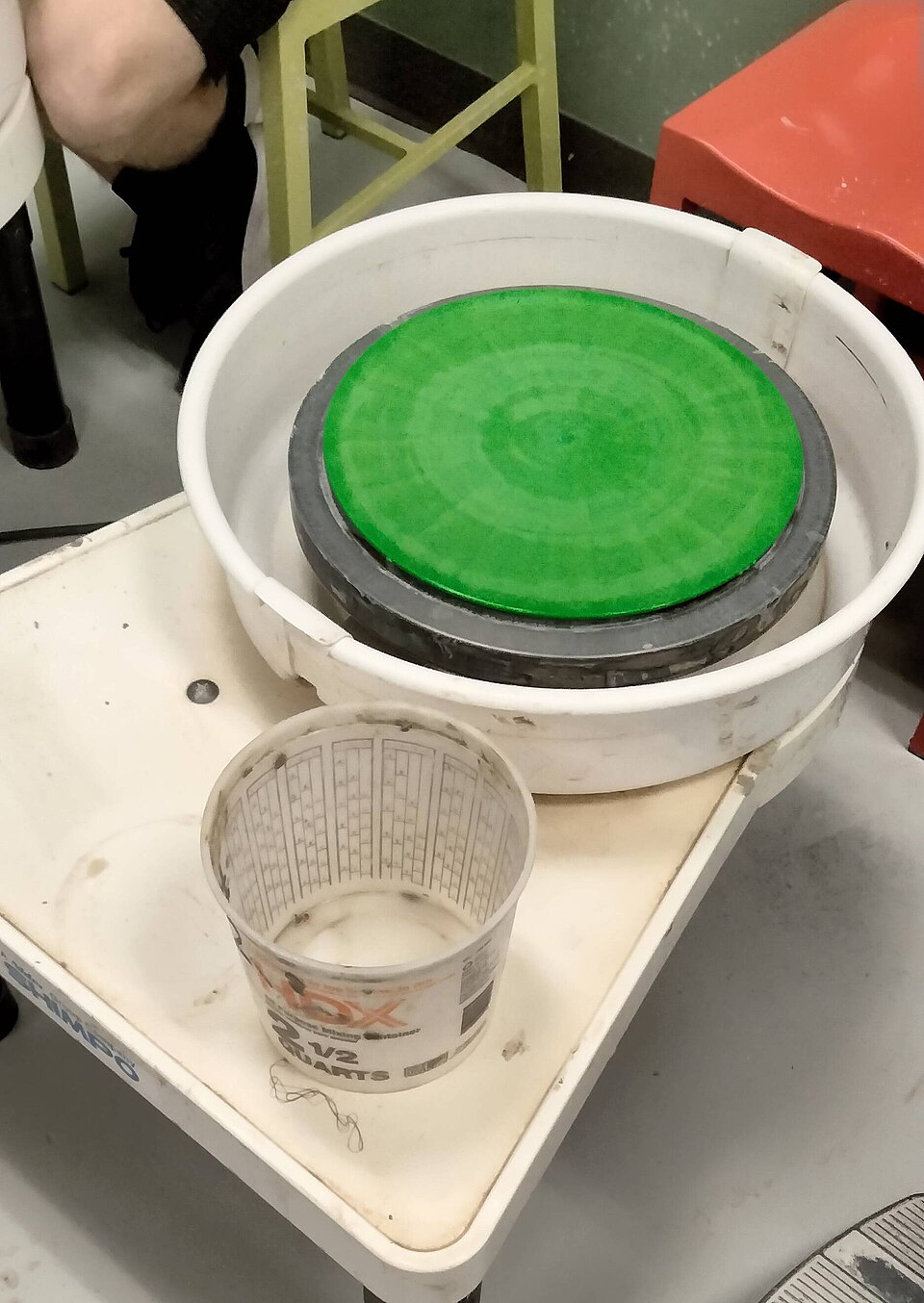
The Artista weighs 26 pounds and sits on a table, with the head 3-5/8 inches above the tabletop. One person carries it to a car. That is the whole design brief, and it is why community studios and classrooms buy them by the half dozen: cheap enough to equip six stations, light enough to stack in a cupboard between sessions.
The Clay Boss weighs 68 pounds and stays where you put it. Speedball gives it as 29.75 by 24.5 by 17.25 inches, which is a piece of furniture rather than a thing you move.
Both run on ordinary 120 volt household power, so neither needs an electrician, which is the opposite of the situation on the kiln side. If you are pricing a whole studio, the pottery wheel buying guide has the wider market and the first kiln buying guide has the part that does need a circuit.

What about noise, belts and the things that wear out?
Both wheels are belt driven, which puts a rubber intermediary between the motor and the head. Speedball’s own product pages do not name a drive type for either wheel; Sheffield’s Artista listing specifies a Micro V belt and credits it for quiet running.
A belt is a wear part. It stretches, it eventually needs replacing, and that is a $15 to $25 job you might do once in a decade. It is also the reason both wheels are audible in a way a direct-drive DC wheel is not. If you throw at night through a shared wall, neither of these is the answer and the Shimpo VL Whisper is, at roughly $1,780. The Whisper against the Clay Boss is a different comparison with a different verdict.
Warranty is where Speedball puts its own confidence on record. Ten years on the Clay Boss, five on the Artista. That is the manufacturer telling you which drivetrain it expects to outlast the other, and it is consistent with the 1/2 HP industrial motor and the load-sensing control being the more serious machine.
Which one should you buy?
Buy the Artista if you are testing whether pottery sticks, or if you need to move the wheel. At $598 bare it is a genuinely low-risk way to find out, and it will teach you to centre 3 pounds perfectly well. Buy it bare, on a table you already own, with the hand control, and spend nothing else until you know. If you stay with it a year, you will want the pedal. Full detail in the Artista review.
Buy the Clay Boss if you already know you are going to throw. It costs $226 more than a fully configured Artista and delivers four times the capacity, 62 percent more head area, load-sensing speed control, reversible rotation and twice the warranty. That is not a close decision at that price, and it is the reason the Clay Boss is the wheel most home studios end up with. Full detail in the Clay Boss review.
Buy the Artista and stop there if a hand control is the point. For seated demonstration work, decoration on a slow turn, or a thrower for whom a foot pedal is not usable, the Artista’s standard configuration is not a compromise at all. Do not add $295 of accessories to a wheel that already does what you need.
Buy neither if you want the wheel to be the last one. A Brent Model C or a VL Whisper is a different class of machine with a different service life, and the best pottery wheels roundup sorts the whole field by buyer.
One number to carry away. The Artista is cheaper per square inch of wheel head when you buy it bare, and 3.2 times dearer per pound of centering capacity once you have made it a seated, pedal-driven wheel. Both of those are true at the same time. Which one describes your studio is the only question this comparison actually asks.