kiln-guides 17 min read
Heat Treat Oven for Knife Making: What Actually Matters
Why a knife oven is not a pottery kiln: soak accuracy, blade-length chambers, front doors and quench speed. Evenheat and Paragon options, with verified prices.
A heat treat oven differs from a pottery kiln in four ways that decide whether a blade hardens: a long shallow chamber shaped like a blade, a door you can open at 1,950F, a controller that holds a soak to the minute, and a tempering range a kiln cannot resolve. Evenheat and Paragon build them from roughly $2,300.
None of those four is about maximum temperature. Most pottery kilns already reach 2,350F. The kiln loses on everything else.
What does knife steel actually ask of an oven?
The published schedules are specific in a way pottery firing is not. Below are six schedules read from the steel suppliers’ own documents on 1 August 2026.
| Steel | Preheat | Austenitise | Soak at temperature | Temper |
|---|---|---|---|---|
| 15N20 | none published | 1,450 to 1,480F | 5 to 15 min | 2 x 2 hr, 300 to 650F |
| 80CrV2 | none published | 1,465 to 1,480F | 5 to 15 min | 2 x 2 hr, 300 to 650F |
| O-1 | none published | 1,465 to 1,480F | 20 to 30 min | 2 x 2 hr, 300 to 650F |
| D-2 | 1,200F then 1,400F, 10 to 15 min each | 1,850F | 30 min | 2 x 2 hr, 300 to 600F |
| AEB-L | 1,500F, hold 15 min | 1,950F | 15 min | 2 x 2 hr, 300 to 500F |
| CPM 3-V | 1,550F, hold 10 to 15 min | 1,950F | 30 min | 3 x 2 hr, 975 to 1,000F |
| CPM 154 | 1,400F, equalise | 1,900 to 2,000F | 30 to 60 min | 2 x 2 hr min, 400 to 1,200F |
Simple carbon and tool steel schedules from New Jersey Steel Baron’s published heat treat documents; CPM 154 from Crucible Industries’ own data sheet, DS 07/10. Both retrieved 1 August 2026.
Read the second column. The window on 80CrV2 is 15 degrees wide. AEB-L wants a preheat, a stop at 1,500F for exactly a quarter of an hour, then a fast climb to 1,950F and another 15 minutes there. CPM 3-V tempers three times at 975F, a temperature that would ruin most of the steels above it in the same table.
And then there is the instruction that shapes the whole machine. New Jersey Steel Baron puts it in bold on three of their sheets: “Do not put blades in oven when cold, insert at or just below austenizing temperature.” On the powder steels they add “Ramp AFAP (as fast as possible) between preheating and austenizing temps.”
An oven you load cold cannot follow either instruction. That single line is why knife ovens have doors.
Why not just use a pottery kiln?
Because a kiln is designed to hold a chamber full of clay at a slowly-approached peak for a few minutes, and heat treating is the opposite job. Here is the comparison honestly, requirement by requirement.
| What the schedule needs | Knife oven | Top-loading pottery kiln |
|---|---|---|
| Reach 1,950F to 2,000F | Yes. KO and Paragon KM to 2,350F, KH and LB to 2,200F | Yes. Cone 10 kilns are rated 2,350F |
| Hold a soak to the minute | Yes, and the chamber is small enough to be even | Controller can, but the thermocouple reads one point in a chamber two feet deep |
| Load steel INTO a hot chamber | Yes. Front or side door at bench height | No. You are lifting a lid off an open pit at 1,950F |
| Blade out and into oil in seconds | Yes. Door opens, fork slides under, straight to the tank | Reaching down into a top-loader with tongs |
| A blade-shaped chamber | 13.5 to 49.5 inches long, 4.25 to 6.25 high | Round, 17 to 28 inches across |
| Temper at 375 to 450F | LT ovens run to 1,200F, sized for the low range | Kiln controllers and elements are built for the top end |
| Repeated fast cycles to 1,950F | Elements and relays specified for it | Elements sized for slow cone firings |
Three of those seven are physical facts about the box rather than anything a better controller can fix, and the loading one is the worst. Getting a 1,950F blade out of a top-loading kiln means standing over an open chamber radiating at you, reaching down with tongs, and lifting straight up before you can move sideways to the quench tank. Evenheat’s own argument for side-opening doors on the KO series is exactly this: it keeps the superheated door away from you during the quench.
The controller, interestingly, is the one place the two worlds overlap. Evenheat’s Icon and Icon+ are built on Bartlett’s Spark and Genesis platforms, the same family that runs Skutt and L&L pottery kilns. What Evenheat adds is low-error Special Limits thermocouple wire, a tighter tolerance grade than standard type K. If you want the pottery side of that story, our kiln controller guide covers the Bartlett ecosystem.
Where a pottery kiln genuinely can help: annealing, normalising cycles that do not need a fast quench, and low-temperature stress relief. If you already own a small kiln and want to test the water before spending $2,400, those are the jobs to give it. Hardening is not one of them.
And a forge? Is an oven really better?
For hardening, yes, and the steel sheets say so directly. New Jersey Steel Baron’s note on soak times is that the short end of every range exists for people heat treating in a forge, because “forge heat treating without PID temperature control limits accurate means of maintaining temperature.” On O-1 they go further: the soak “is a crucial factor and not recommended for forge heat treating.”
A forge is a superb tool for moving metal. It is a poor instrument for holding 1,950F plus or minus a few degrees for fifteen minutes, because it has no feedback loop and no way to know when the middle of the blade caught up with the surface. The oven is not replacing the forge. It replaces the guess at the end of it.
Which Evenheat oven fits which shop?
Evenheat is the default answer in most American knife shops, and the line is organised by chamber length and voltage rather than by feature tier. All specifications below are from Evenheat’s own model pages; prices are The Ceramic Shop’s list and selling figures read on 1 August 2026, and change with controller choice.
| Model | Chamber (D x W x H) | Cu ft | Supply | Watts | Plug | Max temp | List / street |
|---|---|---|---|---|---|---|---|
| Cube 7 | 7 x 7 x 7 in | 0.20 | 120 V, 12 A | 1,440 | 5-15 | 2,350F | not listed |
| KH 414 | 13.5 x 6.5 x 4.25 | 0.22 | 120 V, 13 A | 1,560 | 5-15 | 2,200F | $2,880 / $2,304 |
| KH 418 | 18 x 6.5 x 4.25 | 0.29 | 120 V, 13 A | 1,560 | 5-15 | 2,200F | $3,005 / $2,404 |
| LB 18 | 18 x 10 x 6.25 | 0.68 | 240 V, 13 A | 3,120 | 6-20 | 2,200F | $2,910 / $2,328 |
| LB 27 | 27 x 10 x 6.25 | 1.00 | 240 V, 15 A | 3,600 | 6-20 | 2,200F | $3,210 / $2,568 |
| KO 18 | 18 x 9 x 5.5 | 0.52 | 240 V, 13 A | 3,120 | 6-20 | 2,350F | $3,035 / $2,428 |
| KO 27 | 27 x 9 x 5.5 | 0.77 | 240 V, 15 A | 3,600 | 6-20 | 2,350F | $3,300 / $2,640 |
| KF 31.5 | 31.5 x 10 x 6.25 | 1.18 | 240 V, 30 A | 7,200 | 6-50 | 2,200F | $5,255 / $4,204 |
| KF 49.5 | 49.5 x 10 x 6.25 | 1.86 | 240 V, 30 A | 7,200 | 6-50 | 2,200F | $5,750 / $4,600 |
| LT 18 | 18 x 10 x 4.25 | 0.44 | 120 V, 13 A | 1,560 | 5-15 | 1,200F | not listed |
| LT 27 | 27 x 10 x 4.25 | 0.66 | 120 V, 13 A | 1,560 | 5-15 | 1,200F | not listed |
Four things worth pulling out of that table.
The KH series exists because you have no 240-volt circuit. It is Evenheat’s answer for a garage with nothing but wall outlets, and it takes its form from the LB and KO shop models. The 418 is the deep one at 18 inches and the more popular of the pair.
The KO’s extra 150 degrees is the difference that matters. LB and KF stop at 2,200F, KO reaches 2,350F. Look back at the steel table: CPM 154’s range tops out at 2,000F and even MagnaCut-class powder steels sit below 2,200F, so 2,200F clears everything on this page. The KO’s headroom buys margin, not capability. If you fire near the top of a range routinely, margin is worth having.
Only the KF series is a 30-amp machine. Everything else in the line runs on 20-amp circuits. Jumping from a KO 27 to a KF 31.5 costs $1,564 at street and a new circuit, and buys 4.5 inches of length plus a second door.
The LT series is not a heat treat oven. It stops at 1,200F and is built to sit on top of a matching LB, KO or KF and do nothing but temper. Buying one because it is cheaper is the classic mistake in this category.
Where does Paragon fit?
Paragon has been building knife furnaces since 1986 and its KM series is the traditional alternative: firebrick, a drop-down door with a counterweight handle or a side-swing door at no extra charge, and lengths from the KM14 up to the KM45.
Two Paragon design details are genuinely good and worth naming. A door micro safety switch cuts power to the elements the moment the door opens, while the controller keeps reading temperature. That is the correct behaviour for a machine you open at 1,950F with steel tongs. And the elements sit in dropped, recessed grooves machined into the firebrick, exposed rather than embedded, so a maker can thread new ones in following the manual instead of buying a chamber.
The prices I could verify at a live dealer page on 1 August 2026: the KM14T at $2,520 against a $2,800 MSRP at Clay-Planet, and the KM45 with drop door at $3,510 against $3,900 at The Ceramic Shop.
Now the caveats, because they are real. Paragon’s own store, paragonkilns.com, lists prices but no electrical specifications. The electrical figures for this brand come from dealers, and dealers disagree.
Specifically: Clay-Planet’s KM14T listing gives 120 volts, 1,920 watts, 14 amps and a NEMA 5-15R plug. Those numbers do not reconcile. 1,920 watts at 120 volts is 16 amps, not 14. Sixteen amps is more than a 15-amp receptacle circuit should carry at all, let alone continuously. Kiln Frog lists the same oven at 16 amps on a NEMA 5-20R, which does add up. Get the actual amperage from Paragon or the dealer in writing before you plan the circuit, and read the next section before you plug anything in.
Evenheat or Paragon?
Under 27 inches of blade, buy Evenheat. A KO 18 has twice the chamber cross-section of any Paragon KM, costs less than the KM18 it competes with, runs on 240 volts instead of 120, carries a two-year warranty against Paragon’s one, and publishes electrical figures that add up. Per inch of blade length the two brands come out close. Per cubic inch of chamber, Evenheat costs about half as much, because a Paragon KM chamber is 5.5 inches wide by 4.25 high against the KO’s 9 by 5.5.
| Model | Chamber D x W x H (in) | Cu ft | Supply | Street price | $ per cu in | $ per inch of depth |
|---|---|---|---|---|---|---|
| Evenheat KH 418 | 18 x 6.5 x 4.25 | 0.29 | 120 V | $2,688 | $5.41 | $149 |
| Paragon KM18 | 18 x 5.5 x 4.25 | 0.24 | 120 V | $3,015 | $7.17 | $168 |
| Evenheat KO 18 | 18 x 9 x 5.5 | 0.52 | 240 V | $2,600 | $2.92 | $144 |
| Paragon KM24 | 24 x 5.5 x 4.25 | 0.33 | 240 V | $3,420 | $6.10 | $143 |
| Evenheat KO 27 | 27 x 9 x 5.5 | 0.77 | 240 V | $2,924 | $2.19 | $108 |
| Paragon KM36 | 36 x 5.5 x 4.25 | 0.49 | 240 V | $4,050 | $4.81 | $113 |
| Paragon KM45 | 45 x 5.5 x 4.25 | 0.61 | 240 V | $4,770 | $4.53 | $106 |
Street prices read 2 August 2026: Evenheat at Soul Ceramics, Paragon at Paragon’s own store. Both move with controller choice. Volumes are computed from each maker’s published interior dimensions.
Buy Paragon if you need length, zones or gas. Past 27 inches, Evenheat’s only answer is the 30-amp KF series on a NEMA 6-50. Paragon runs to 45 inches on 240 volts and sells multi-zone control for long chambers and an inert-gas inlet, which Evenheat does not. A Paragon also ships with gloves, a fork, firebrick supports and four knife holders, and the drop door suits some benches better.
Check the circuit before you buy a long Paragon. Two dealers list the KM45 at 19 amps on 240 volts, and one names a 20-amp breaker and a NEMA 6-20. Nineteen amps of continuous load needs a breaker rated at least 23.75 amps, so the draw and that circuit cannot both be right. The KM18 shows the same gap: 17 amps on a 20-amp, 120-volt circuit. Get the amperage from Paragon in writing before you book the electrician.
What circuit does a knife oven need?
This is the part where the internet gets casual and the code does not. A heat treating cycle runs for hours, so under the National Electrical Code (NFPA 70, 2023) Article 100 it is a continuous load: one whose maximum current is expected to continue for three hours or more. Section 210.20(A) then requires the overcurrent device to be rated at not less than the noncontinuous load plus 125 percent of the continuous load.
Apply that to the ovens above.
| Oven | Draw | 125% of draw | Practical minimum circuit |
|---|---|---|---|
| Evenheat Cube 7 | 12 A at 120 V | 15.0 A | 20 A dedicated, 12 AWG |
| Evenheat KH 414 / 418, LT series | 13 A at 120 V | 16.25 A | 20 A dedicated, 12 AWG |
| Paragon KM14T | 1,920 W, so 16 A at 120 V | 20.0 A | 20 A dedicated at the absolute limit; confirm the real draw |
| Evenheat LB 18, KO 18 | 13 A at 240 V | 16.25 A | 20 A, NEMA 6-20 |
| Evenheat LB 27, KO 27 | 15 A at 240 V | 18.75 A | 20 A, NEMA 6-20 |
| Evenheat KF series | 30 A at 240 V | 37.5 A | 40 A minimum; Evenheat specifies a NEMA 6-50 plug |
Draws from each manufacturer’s published specification. The 125 percent factor is NEC 210.20(A) applied to a continuous load; the final circuit is your electrician’s call, not a table’s.
The practical upshot for the 120-volt ovens is the one nobody mentions: a KH 418 shipped with an ordinary NEMA 5-15 plug should not live on an ordinary 15-amp general-purpose circuit. Thirteen amps continuous needs a 20-amp breaker with 12 AWG conductors, on a circuit doing nothing else. A 5-15 plug fits a 20-amp 5-20R receptacle, so this costs you an electrician’s visit, not a different oven.
Every 240-volt install is licensed-electrician work, without exception. New circuit, panel capacity check, correct receptacle, and in most jurisdictions a permit and inspection. Our kiln electrical requirements guide has the wire gauge and receptacle detail, and it applies identically here because a knife oven is electrically just a small kiln.
Tempering is a separate problem
Hardening gets the attention. Tempering is where the hardness you just created is turned into a knife rather than a very brittle bar, and every schedule in the steel table asks for two or three two-hour holds somewhere between 300F and 650F.
That is an awkward range for a high-temperature machine. It is why Evenheat sells the LT series, capped at 1,200F and designed to stack on the oven that did the hardening, and why New Jersey Steel Baron’s O-1 sheet gives explicit advice for people using a domestic oven instead: use “a blade holding rack made from kiln furniture, a roasting tray lined with fine sand, or similar large object” to add thermal mass, “to reduce wide swinging temperatures as the device fluctuates trying to maintain temperature.”
That instruction is a warning about the whole class of low-temperature holds. A cycling element with nothing to buffer it overshoots and undershoots, and at 400F a 40-degree swing moves you a full Rockwell point on the published table.
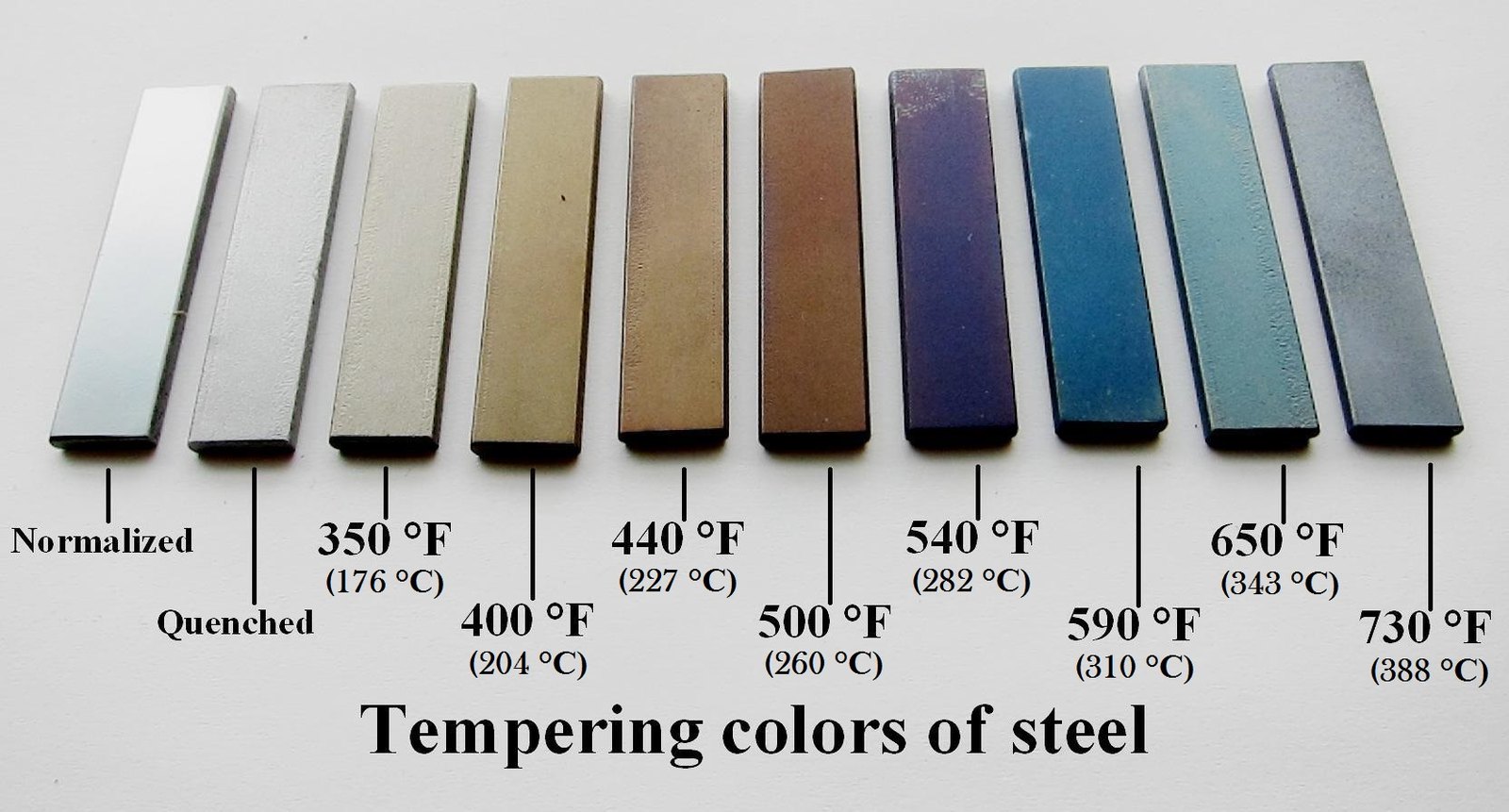
One more trap, from Crucible’s own CPM 154 sheet: tempering stainless at 800 to 1,100F causes sensitization, reducing both corrosion resistance and toughness, and Crucible recommends the range be avoided. New Jersey Steel Baron repeats the warning at 800F on both AEB-L and D-2. Meanwhile CPM 3-V, which is not stainless, is tempered at 975F. Knowing which sheet you are following matters more than knowing your oven.
What does it cost to run?
Very little, which surprises people who have priced these ovens.
Elements cycle rather than running continuously, so energy is rated wattage times hours times an average duty cycle. Figures below use a 50 percent average duty cycle for hardening, the basis every cost table on this site uses, and the US average residential rate of 18.44 cents per kilowatt hour from the EIA’s May 2026 data, released 23 July 2026. A two-hour hardening run and a four-hour double temper is a realistic single-batch cycle.
| Oven | Harden, 2 hr | Double temper, 4 hr | Full cycle |
|---|---|---|---|
| Evenheat Cube 7, 1.44 kW | $0.27 | $0.53 | $0.80 |
| Evenheat KH 418, 1.56 kW | $0.29 | $0.58 | $0.87 |
| Paragon KM14T, 1.92 kW | $0.35 | $0.71 | $1.06 |
| Evenheat KO 18 / LB 18, 3.12 kW | $0.58 | $1.15 | $1.73 |
| Evenheat KO 27 / LB 27, 3.60 kW | $0.66 | $1.33 | $1.99 |
| Evenheat KF 31.5, 7.20 kW | $1.33 | $2.66 | $3.99 |
The tempering column is an upper bound. At 400F an oven’s elements duty-cycle far below 50 percent, so real tempering cost is lower than shown.
Under two dollars of electricity to harden and temper a batch of blades in a shop-standard KO 27. For comparison, a glaze firing in a full studio pottery kiln runs from about $9 in a Skutt KM-818 to about $16 in a KM-1027, which the cost to fire a kiln guide works out model by model. The running cost is not the decision. The oven price, the circuit, and whether you want the process in your own hands are the decision. Commercial per-blade heat treat is quoted rather than published, so we are not going to put a break-even number on this page that we could not verify.
What else do you need?
Foil or anti-scale coating. Every oven on this page is air atmosphere, so bare steel scales and decarburises at 1,950F. Type 309 stainless foil made into a pouch is the standard answer. The alternative is an anti-scale coating such as ATP-641, which is not sold on Amazon; get it from a knife supply house.
A quench oil matched to the steel, not to the shelf. New Jersey Steel Baron names Parks 50 for 15N20, Parks AAA or an 11-second oil for 80CrV2, and states plainly that Parks 50 is not recommended for O-1. The same fast oil that saves one steel cracks another.
Tongs you can work in one motion. The blade goes from door to oil in seconds. Paragon sells a 31-inch heat treating fork and ceramic knifeholders for exactly this, and the sliding wooden handle exists so you are not standing square to the open door.
A way to check hardness. Hardness files will tell you whether the blade hardened. Every published schedule is explicit that files and chisels are relative and inaccurate for a true value, and that only a calibrated Rockwell tester gives a real number. Use the files to catch a failed quench, not to certify a blade.
Plate quench setup for the powder steels. AEB-L, CPM 3-V and D-2 all specify quenching under positive pressure between aluminium plates with compressed air, to at or below 125F. That is a bench fixture, not an oven accessory, and it is not optional if you want the published hardness.
Do you actually need one?
Not if you make four knives a year. Send them out, and spend the money on grinding.
Buy an oven when one of three things is true. You are making enough blades that turnaround time has become the bottleneck. You are working steels whose schedules you want to control yourself, which in practice means the stainless and powder grades where a 15-minute soak at 1,950F is the whole game. Or you are testing, in which case owning the process is the point.
Start at a KH 418 if your shop has no 240-volt circuit and you make knives under 18 inches. Start at a KO 18 if it does, because the door design and the 2,350F ceiling are worth $124 over an LB 18 at street prices. Go to a KF only when blade length forces it, and remember that decision brings a 30-amp circuit with it.
And if you are coming at this from the ceramics side and already own a small kiln, read the Skutt FireBox review and the Paragon Caldera review before you talk yourself into using one for hardening. A Caldera reaches 2,350F and cannot be opened at that temperature with a blade in your tongs, which is the whole argument on this page in a single sentence.
The tools in Further reading are the consumables and test gear that go with the oven. Elements, thermocouples and relays go through Evenheat, Paragon or an authorised distributor, because they have to match the model, voltage and phase. As an Amazon Associate we earn from qualifying purchases.