kiln-reviews 11 min read
Skutt FireBox Review: The 120-Volt Mini Kiln Lineup
Skutt's FireBox 8x6 and 8x4 plug into a household outlet. Verified specs, the cone rating that runs backwards, and what each one actually costs to fire.

Skutt’s FireBox line is three plug-in mini kilns running on ordinary household power: the 8x4 LT and the 8x6 LT, each with an 8 by 8 inch opening, and the glass-only FireBox 14 at 15 by 15. All three draw 15 amps at 115 volts through a standard NEMA 5-15 outlet. The cone ratings, though, run backwards.
The shallower kiln is the hotter one. Skutt rates the 8x4 LT to cone 10 and the deeper 8x6 LT to cone 6, and that single line in their own specification table decides which one most buyers should be shopping for.
Which FireBox models does Skutt actually sell?
Three, and they live in two different catalogues, which is the first thing that confuses people searching for this kiln.
The FireBox 8x4 LT and FireBox 8x6 LT both appear under Ceramic Kilns on skutt.com and both appear on the 2026 ceramic price list. The FireBox 14 appears only under Glass Fusing Kilns and only on the glass price list. It is not a ceramics kiln and Skutt does not present it as one. Its ceiling is 1,700F, which is below cone 06.
There is also a FireBox 8 MTS row sitting in Skutt’s own specification table, rated to 2,000F with no cone value against it. Skutt does not give it a product page of its own. If a dealer offers you one, ask which of the three you are actually buying.
Prices below are Skutt’s own list, effective 10 January 2026, FOB Portland. Dealers discount, sometimes heavily, and the third column is what one dealer was actually charging on the day this was written.
| Model | Skutt 2026 list | The Ceramic Shop, 1 Aug 2026 | Discount |
|---|---|---|---|
| FireBox 8x4 LT | $1,410 ceramic list / $1,355 glass list | not listed | n/a |
| FireBox 8x6 LT | $1,490 | $1,199 | 20% |
| FireBox 14 | $1,905 | $1,598 | 16% |
Yes, the 8x4 carries two different list prices in two Skutt documents published the same day. Same model code, same specification row, $55 apart. Skutt does not explain the gap on either list, so treat $1,410 as the ceiling and ask the dealer what is in the box.
The specifications
Every figure here comes from Skutt’s own product specification tables, cross-checked against the two 2026 price lists.
| Specification | FireBox 8x4 LT | FireBox 8x6 LT | FireBox 14 |
|---|---|---|---|
| Chamber opening | 8.00 x 8.00 in | 8.00 x 8.00 in | 15.00 x 15.00 in |
| Chamber depth | 4.5 in | 6.5 in | 6.5 in |
| Published volume | 0.2 cu ft | 0.2 cu ft (0.22 on the capacity calculator) | 0.8 cu ft |
| Maximum temperature | Cone 10, 2,350F | Cone 6, 2,250F | 1,700F, no cone rating |
| Voltage | 115 V, 1 phase | 115 V, 1 phase | 115 V, 1 phase |
| Amperage | 15 A | 15 A | 15 A |
| Wattage | 1,725 W | 1,800 W | 1,725 W |
| Receptacle | NEMA 5-15 | NEMA 5-15 | NEMA 5-15 |
| Controller | Mini Touchscreen | Mini Touchscreen | Mini Touchscreen |
| Shipping weight | 53 lb | 58 lb | 110 lb |
| Carton | 24 x 19 x 19 in | 24 x 19 x 19 in | 32 x 32 x 28 in |
Why does the shallower FireBox fire hotter?
Because all three kilns are stuck behind the same wall: a 15-amp household circuit. At 115 volts that caps the kiln at roughly 1,800 watts no matter what Skutt would prefer to build. Once the power is fixed, the only remaining levers are how much chamber that power has to heat and how well the brick holds what it makes.
Work out watts per cubic inch of chamber and the shape of the problem shows up immediately.
| Kiln | Chamber (cu in) | Watts | Watts per cu in | Published ceiling |
|---|---|---|---|---|
| Skutt FireBox 8x4 LT | 288 | 1,725 | 5.99 | Cone 10, 2,350F |
| Skutt FireBox 8x6 LT | 416 | 1,800 | 4.33 | Cone 6, 2,250F |
| Paragon Caldera | 432 | 1,680 | 3.89 | Cone 10, 2,350F |
| Skutt FireBox 14 | 1,462 | 1,725 | 1.18 | 1,700F, no cone |
Chamber volumes computed from each manufacturer’s published opening and depth. Wattages from Skutt’s specification tables and The Ceramic Shop’s Caldera listing, both read 1 August 2026.
The extremes behave exactly as you would expect. The 8x4 has the most power per unit of space and the highest ceiling. The FireBox 14 has one fifth of that power density and stops 650 degrees short of cone 6.
The Caldera breaks the ordering, and it is worth saying so rather than pretending the pattern is cleaner than it is. Paragon’s kiln has less power per cubic inch than the 8x6 and reaches 100 degrees higher. Insulation is the difference: The Ceramic Shop’s listing specifies a 2.5 inch insulating firebrick chamber on the Caldera. Power density tells you how hard a small kiln has to work. It does not, on its own, tell you where it stops.
What does a FireBox cost to fire?
Almost nothing, which is the honest headline for every kiln on a 15-amp plug.
Elements cycle on and off rather than running flat out, so energy used is rated wattage multiplied by hours multiplied by an average duty cycle. The figures below use a 50 percent average duty cycle across the firing, which is the same basis every cost table on this site uses, and the US average residential rate of 18.44 cents per kilowatt hour from the EIA’s May 2026 data, released 23 July 2026.
| Firing | Kiln | Hours | kWh | Cost |
|---|---|---|---|---|
| Bisque, cone 04 | FireBox 8x6 | 3 | 2.70 | $0.50 |
| Glaze, cone 6 | FireBox 8x6 | 5 | 4.50 | $0.83 |
| Full fuse plus anneal | FireBox 8x6 | 5 | 4.50 | $0.83 |
| Silver clay at 1,650F, 2 hr hold | FireBox 8x4 | 3 | 2.59 | $0.48 |
| Glaze, cone 10 | FireBox 8x4 | 5 | 4.31 | $0.80 |
| Full fuse plus anneal | FireBox 14 | 6 | 5.18 | $0.95 |
Fire an 8x6 twice a week, every week, and the electricity comes to about $86 a year. Rate and hours are both stated above so you can substitute your own utility rate; the kiln is not the expensive part of owning a kiln. If you want the same arithmetic for a full-size studio kiln, the cost to fire a kiln guide runs it across the whole Skutt and L&L range.
Is 115 volts really the same as 120 volts?
Yes, and the mixed labelling on Skutt’s own website is worth explaining once because it worries people.
Skutt’s specification tables say 115 volts. Skutt’s marketing copy on the same page says “plug it into any spare 120V outlet you have in the house.” Both describe the identical circuit. A standard North American branch circuit is nominally 120 volts, and 115 volts is the older equipment-rating convention for the same supply, the same way motors are still stamped 115/230. No adapter, no transformer, nothing to reconcile.
What does matter is what else is on that circuit. Fifteen amps is the whole circuit, and a FireBox draws all of it. Share the breaker with a space heater or a shop vacuum and the breaker trips partway through a schedule, which on a glass anneal means starting again. Give it its own circuit if you have one. And Skutt’s own caveat still applies, phrased in their words: “Okay, it does need to be a grounded outlet.”
For anything larger than a FireBox this stops being simple. The kiln electrical requirements guide has the breaker, wire gauge and receptacle table by model, and the point where a licensed electrician stops being optional.
What does the Mini Touchscreen controller actually do?
More than the price suggests. Skutt replaced the old three-button controller across the FireBox line with the Mini Touchscreen, and it runs three preset modes plus full manual programming.
GlassFire mode takes a technique and a firing speed and writes the schedule for you. ConeFire mode takes a cone value, a firing speed and a hold time, which is the ceramics path. PMC mode takes the type of precious metal clay, gold, silver or copper, and handles the rest.
Underneath the presets you get up to 30 stored programs with 8 ramp-and-hold segments each. Mid-firing you can push the temperature or the hold with Add Temp and Add Time, or jump straight to annealing with Anneal Now, which is the feature glass people reach for when a fuse looks further along than the clock says.
Skutt sells a Mini Touchscreen Upgrade Kit for $305 to convert an older three-button FireBox. If you are shopping used, that number is the difference between a bargain and a project.
What actually fits in an 8 by 8 inch chamber?
A single shelf of small work, and that is the whole answer.
The 8x6 ships with one shelf, three posts and a bag of kiln wash, so the practical footprint is one 7 by 7 inch shelf plus whatever clears underneath it. Skutt sells the FireBox 8x4 and 8x6 furniture kit at $50, with 7 by 7 by half-inch shelves at $39 each and half-inch posts at $3.00.
That holds pendants, earrings, beads, enamel work, a dozen glass cabochons, a row of test tiles, or one small sculptural piece. It does not hold a mug. It does not hold a bowl. Nothing in the 8 by 8 family fires functional tableware, and no arrangement of shelves changes that.
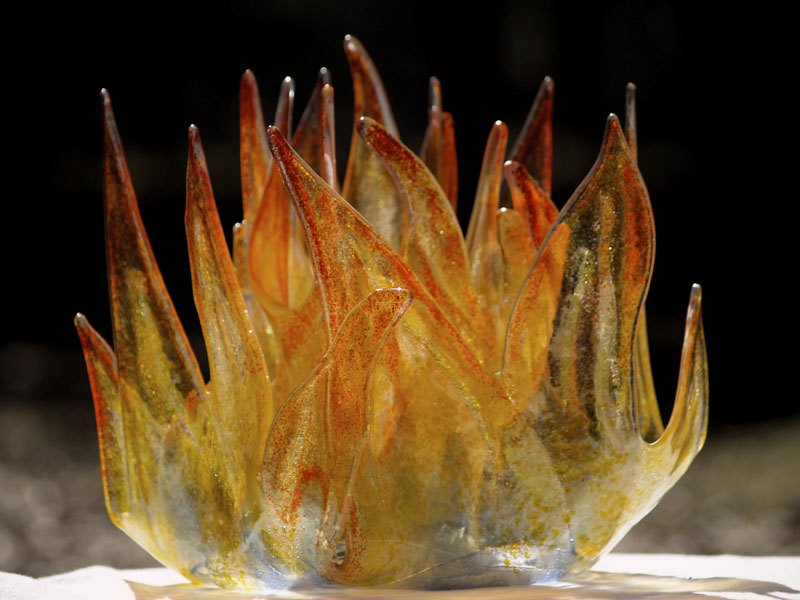
The FireBox 14 is a genuinely different proposition on capacity. Skutt rates it for a full square foot of tile or a 12 inch square plate, and its 6.5 inch depth clears slump moulds up to 4 inches deep. But it is a fusing kiln at 1,700F, so the capacity buys you bigger glass, not pottery. If glass is the whole point, the glass fusing kiln guide works through schedules and kiln choice together.
What does small actually cost you?
Here is the number nobody puts on a product page. Divide list price by chamber volume and small stops looking cheap.
| Kiln | List price | Chamber (cu in) | Price per cu in |
|---|---|---|---|
| Skutt FireBox 8x4 LT | $1,410 | 288 | $4.90 |
| Paragon Caldera | $1,800 | 432 | $4.17 |
| Skutt FireBox 8x6 LT | $1,490 | 416 | $3.58 |
| Skutt FireBox 14 | $1,905 | 1,462 | $1.30 |
| Skutt GlazeTech | $2,330 | 1,892 | $1.23 |
| Skutt KM-818 | $2,940 | 4,493 | $0.65 |
Skutt list prices from the 2026 ceramic and glass price lists, effective 10 January 2026. Caldera list from The Ceramic Shop, 1 August 2026. Chamber volumes computed from published dimensions; the KM-818 uses its published 2.6 cubic feet.
An 8x4 costs seven and a half times as much per cubic inch of chamber as a KM-818. That is not a criticism of the FireBox. You are paying for the 15-amp plug, not for space, and if a 240-volt circuit is impossible then the ratio is irrelevant because the alternative is no kiln at all.
But if you can run 240 volts, the table is the argument for stepping up. The GlazeTech at $2,330 gives you a cone 10 chamber over four times larger than an 8x6 for $840 more. That is the decision most people are actually making when they type “small kiln” into a search box, and the small kilns guide lays the tier out properly.
The warranty and what it covers
Skutt’s language is unusually direct here, so it is worth quoting rather than summarising. Their warranty “covers Parts AND Labor,” is “Never Pro-Rated,” and is serviced through their distributor network rather than by shipping the kiln back.
That is a real differentiator at this price. A parts-only warranty on a $1,200 kiln means a service call can cost a meaningful fraction of the kiln. Skutt does not publish the term length on either price list, so confirm it in writing with the dealer before you buy.

Who should buy something else?
You want cone 6 stoneware in a plug-in kiln. The 8x6 is rated to cone 6 and will get there, but with 416 cubic inches you are firing test tiles, not pots. Put a witness cone on the shelf and read what the kiln actually did rather than what the display claims. Our pyrometric cones guide explains why the controller and the cone disagree more often at the small end.
You want cone 10 and depth. The 8x4 gives you cone 10 with 4.5 inches of headroom. The Paragon Caldera gives you cone 10 with 6.75 inches for $310 more at list. That comparison is close enough to deserve its own page, and it has one: Caldera versus FireBox.
You want to fire mugs and bowls. Nothing in the 8 by 8 family does this. The smallest kiln in the Skutt range that fires functional ware is the KM-818 at 2.6 cubic feet, and it needs a 240-volt, 40-amp circuit.
You want ceramics from a FireBox 14. It stops at 1,700F. That is a fusing kiln with a tile-sized floor, and it is very good at that, but no cone fires in it.
Verdict
The FireBox 8x6 at $1,199 street is the most kiln you can put on a household outlet without a conversation with an electrician, and the Mini Touchscreen makes it genuinely usable for glass, ceramics and silver clay in the same week. Buy it if your work is small and your panel is not negotiable.
Buy the 8x4 instead only if you specifically need cone 10, and understand that you are trading two inches of chamber height for 100 degrees of ceiling. Buy the FireBox 14 only for glass.
And read the cone rating on the box, not the model number. The bigger FireBox is the cooler one, which is the opposite of what every other kiln lineup on the market has taught you to expect.
The accessories in Further reading below are the consumables and test gear, not kiln-specific parts. Elements, thermocouples and relays should come from Skutt or an authorised distributor, because those parts have to match the model, voltage and phase. As an Amazon Associate we earn from qualifying purchases.