kiln-reviews 6 min read
Skutt KM-818 Review: Compact Cone 10 for Small Studios
The Skutt KM-818 fires to cone 10 in a 2.6 cubic foot chamber on a 40-amp circuit. Verified specs, cost-to-fire math, and owner reports for tight spaces.
The Skutt KM-818 fires to Cone 10 in a 2.6 cubic foot chamber that fits in a spare bedroom closet, a corner of a one-car garage, or a basement studio with a low ceiling. It runs on a 40-amp, 240-volt circuit. Pricing starts at $2,084 at Sheffield Pottery (verified June 2026). For potters with limited studio space, limited electrical capacity, or a budget tighter than the KM-1027 demands, the 818 is the kiln to look at first.
Here is the number nobody puts on the product page
A Cone 6 glaze firing in the KM-818 costs $8.91 in electricity at the US average rate. A bisque costs $5.35. A full bisque-plus-glaze cycle runs about $14.26.
That recurring cost matters more than the sticker price after the first year of use. Ten glaze loads per year costs roughly $89 in electricity.
Specifications
| Specification | Value |
|---|---|
| Interior volume | 2.6 cu ft |
| Interior dimensions | 18” x 18” square, 18” deep |
| Maximum temperature | Cone 10 (2,300°F / 1,260°C) |
| Voltage | 240V |
| Amperage draw | 27.75A |
| Wattage | 6,660W (6.66 kW) |
| Elements | 3 rings, bifilar |
| Controller | Skutt FireBox (standard); JD-100 digital optional |
| Warranty | 1 year |
| Price (Sheffield Pottery, June 2026) | $2,084 sale / $2,605 regular |
The electrical picture
At 27.75 amps, the KM-818 exceeds the 24-amp continuous-load limit of a 30-amp circuit. The NEC’s 80% rule caps sustained loads at 80 percent of circuit capacity. On a 30-amp breaker, that ceiling is 24 amps. The KM-818 draws 27.75 and trips it.
Minimum requirement: a dedicated 40-amp circuit. Most electricians install a 50-amp circuit with a NEMA 6-50 receptacle for kiln work, since 50-amp panels are more common than 40-amp configurations. Wire gauge: 8 AWG copper minimum for a 40-amp run; 6 AWG for a 50-amp installation.
If your studio has an existing 240V outlet for a dryer or range, verify it is on its own dedicated circuit before plugging in a kiln. Shared circuits cause nuisance tripping and can shorten element life. Our kiln electrical requirements guide covers the full picture.
Garage and home studio placement
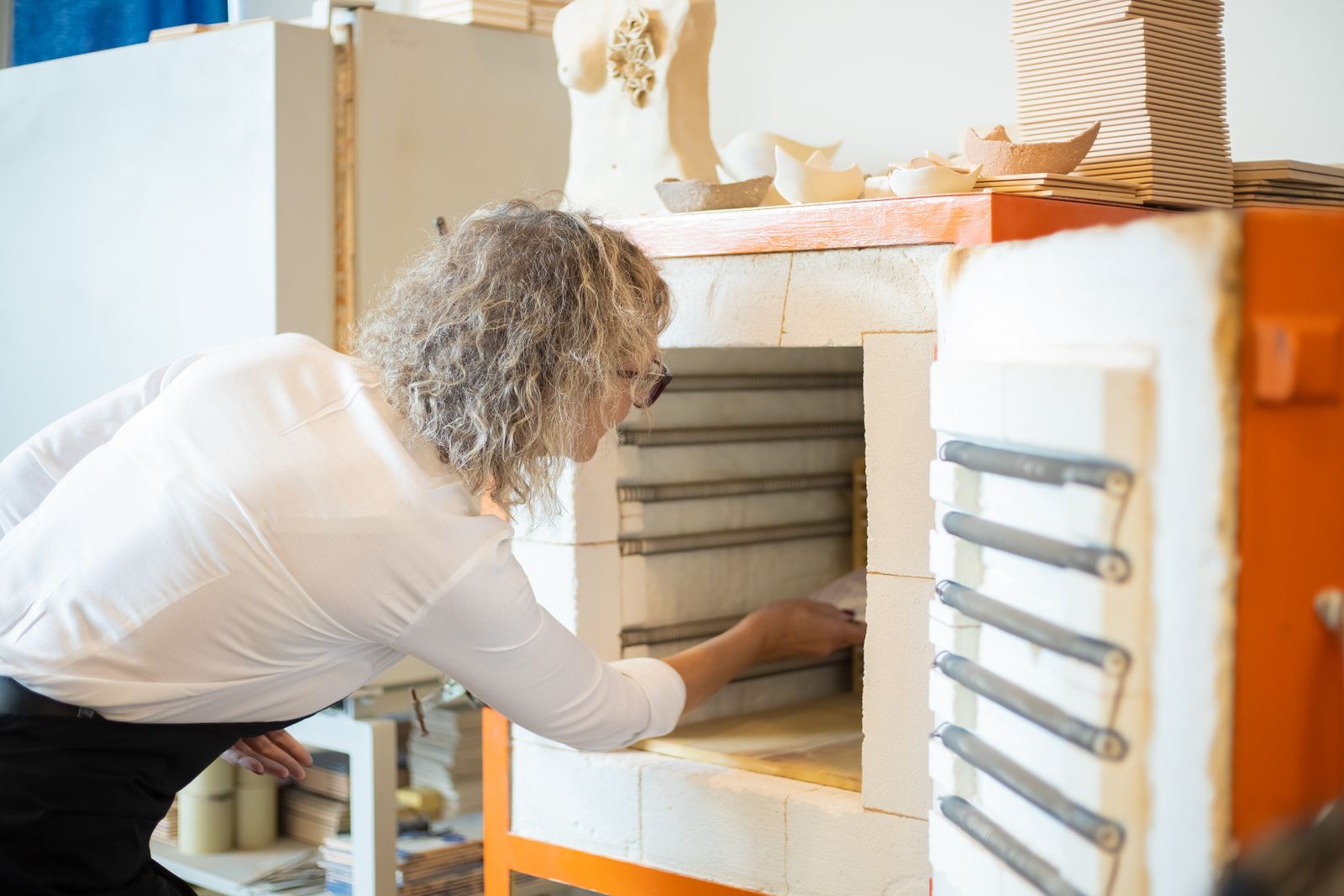
The KM-818 weighs around 150 pounds and occupies a compact footprint. In a standard two-car garage, it leaves ample room for a wheel and a wedging table. In an uninsulated garage in a cold climate, allow extra warm-up time in winter and keep the kiln away from exterior walls where condensation can accumulate.
Ventilation is not optional. Clay body burnout, glaze volatilization, and element offgassing all produce fumes during firing. A purpose-built kiln ventilation system draws air from the kiln chamber and exhausts it outside. A window fan positioned to exhaust outward works as a minimal alternative in a pinch but is not a permanent solution.
The 818’s compact chamber has a practical advantage in a small studio: shorter turnaround. Load fewer pieces, run the firing cycle, unload and reload. A solo potter working in series can complete more cycles per week with an 818 than they could with a larger kiln that takes longer to fill and fire. See our kiln placement guide for clearance requirements and floor protection.
What owners say
Potters who chose the KM-818 over the KM-1018 most often had two things in common: an existing 40-amp circuit from a previous appliance, and a studio where the 1018’s larger footprint was genuinely a problem. A few notes that come up consistently across forums and community groups:
The three-ring element layout produces even top-to-bottom heat when loading is staged on properly spaced shelves. Potters firing mostly Cone 6 say the standard FireBox programs are sufficient. Those who regularly push Cone 10 tend to add the JD-100 digital controller for tighter ramp control.
Element replacement is manageable at home. Skutt’s bifilar elements seat into soft brick grooves; a standard KM-818 element kit takes 30 to 45 minutes to swap. Shelf sets are sold separately and add $80 to $120 to the initial cost.
Cost to fire
Based on the KM-818’s 6.66 kW rating and proportional wattage from the L&L segment duty-cycle method; rate from the EIA, March 2026.
| Firing | Duration | kWh used | Cost at $0.1783/kWh |
|---|---|---|---|
| Bisque (Cone 04) | ~8.5 hr | 30.0 kWh | $5.35 |
| Glaze (Cone 6) | ~14 hr | 50.0 kWh | $8.91 |
| Both combined | ~22.5 hr | 80.0 kWh | $14.26 |
Push the 818 to Cone 10 and the clock runs longer still. Figure several hours beyond the Cone 6 numbers above, since the kiln spends more time climbing through the last few hundred degrees and holding there.
Elements and maintenance
Skutt uses bifilar elements throughout the KM-818: wire wound in a tight double-helix pattern that reduces magnetic stress on surrounding brick and allows elements to fail gradually rather than snapping without warning.
Typical element lifespan in hobby use runs 200 to 350 firings. Cone 6 is gentler on elements than Cone 10. A replacement kit for the 818 costs $80 to $100 in parts. Watch for firings that take longer than usual to reach temperature, or for visible sagging in the element grooves.
Who should buy something else
You throw large pieces regularly. The 18-inch interior handles most functional pottery, but pieces taller than 15 inches or wider than 16 inches in diameter will be a recurring constraint. The Skutt KM-1018 nearly doubles the chamber to 4.6 cubic feet with 24-inch interior dimensions, though the circuit steps up too: a 50-amp breaker instead of the 818’s 40-amp. Both kilns fire to Cone 10, so the choice comes down to space and panel capacity, not temperature range.
You expect to grow quickly. If your production is already consistent and you anticipate doubling output within a year, start with the KM-1018 or KM-1027. Reselling and re-buying kilns costs more than buying the right size once.
You fire Cone 10 as your primary range. Cone 10 is achievable in the 818, but it stresses elements harder than larger kilns where more elements share the thermal load. For a studio built around high-fire work, the 1018 or 1027 will serve you longer between maintenance cycles.
Verdict
The Skutt KM-818 is a fully capable kiln, not a compromised one. It reaches Cone 10, runs on a standard 40-amp circuit, and fits in spaces that rule out larger kilns. At $2,084 on sale at Sheffield Pottery (verified June 2026), it is the least expensive entry point in the Skutt square-body lineup.
The limitation is chamber volume. Know your production sizes before you buy. If 2.6 cubic feet is enough for your work, the 818 delivers everything the larger Skutts do at a lower price and with simpler electrical requirements. If it is not enough, see the KM-1018 review and the best kilns for home studios guide for how the options stack up.