kiln-guides 7 min read
Kiln Ventilation Guide: Downdraft Systems and Room Air
What kilns release during firing, why ventilation matters, how downdraft vent systems work, and how to set up safe venting in a garage or basement studio.
Electric kilns release fumes during firing. Clay bodies contain organic matter that burns off during bisque. Glazes contain mineral colorants and fluxes that volatilize at temperature. Wax resist products used to prevent glaze adhesion produce smoke and VOCs during the early stages of a glaze firing. Without ventilation, these compounds build up in the studio space.
The two main approaches are a dedicated downdraft ventilation system attached to the kiln or direct room ventilation that moves air from the kiln area to the outdoors. Both work; the downdraft system is more reliable and consistent.
What kilns release during firing
Bisque firing burns off organic carbon compounds in the clay body. This produces carbon monoxide and carbon dioxide during the early stages, particularly from cone 1000°F (538°C) to around 1100°F (593°C) where carbonaceous material burns rapidly. Sulfur compounds in some clay bodies also release during this phase.
Glaze firing produces different compounds depending on the glaze chemistry. Lead, barium, and lithium glazes are higher hazard; commercial cone-6 studio glazes are generally lower hazard but still release compounds during firing. Wax resist used on piece bottoms and rims burns off in the first hour and produces the most visible smoke of any firing type.
Both firing types take place at temperatures where thermal byproducts are present in the kiln atmosphere and eventually in the room if ventilation is absent. Neither CO nor most ceramic firing byproducts have a strong detectable odor at low concentrations, which makes passive detection unreliable.

Skutt Vent-Sure: how it works
The Skutt Vent-Sure is a downdraft ventilation system that mounts beneath the kiln. A small motor (typically 25 watts) creates negative air pressure inside the kiln. Small holes drilled in the kiln floor allow air and fumes to flow downward through the floor, into a collection plenum at the base of the kiln, and out through a 4-inch flexible aluminum duct.
The duct runs from the kiln base to a wall or window termination outside the building. For most installations, the duct runs along the floor and exits through an exterior wall or window at approximately floor level. The duct must be sealed at penetrations to prevent fume escape inside the wall.
The Vent-Sure runs from the start of firing through the cool-down phase. For kilns with a delay-start feature, set the vent to run before the kiln elements begin drawing current, so that any initial off-gassing of the clay or kiln furniture is captured.
Skutt’s Vent-Sure is compatible with the KM-1027, KM-1018, KM-818, and other KM-series kilns. Check the Skutt compatibility list for your specific kiln; the vent attachment bracket differs by kiln base dimension. Available at Sheffield Pottery, Krueger Pottery Supply, and Soul Ceramics.
L&L EnviroVent: how it works
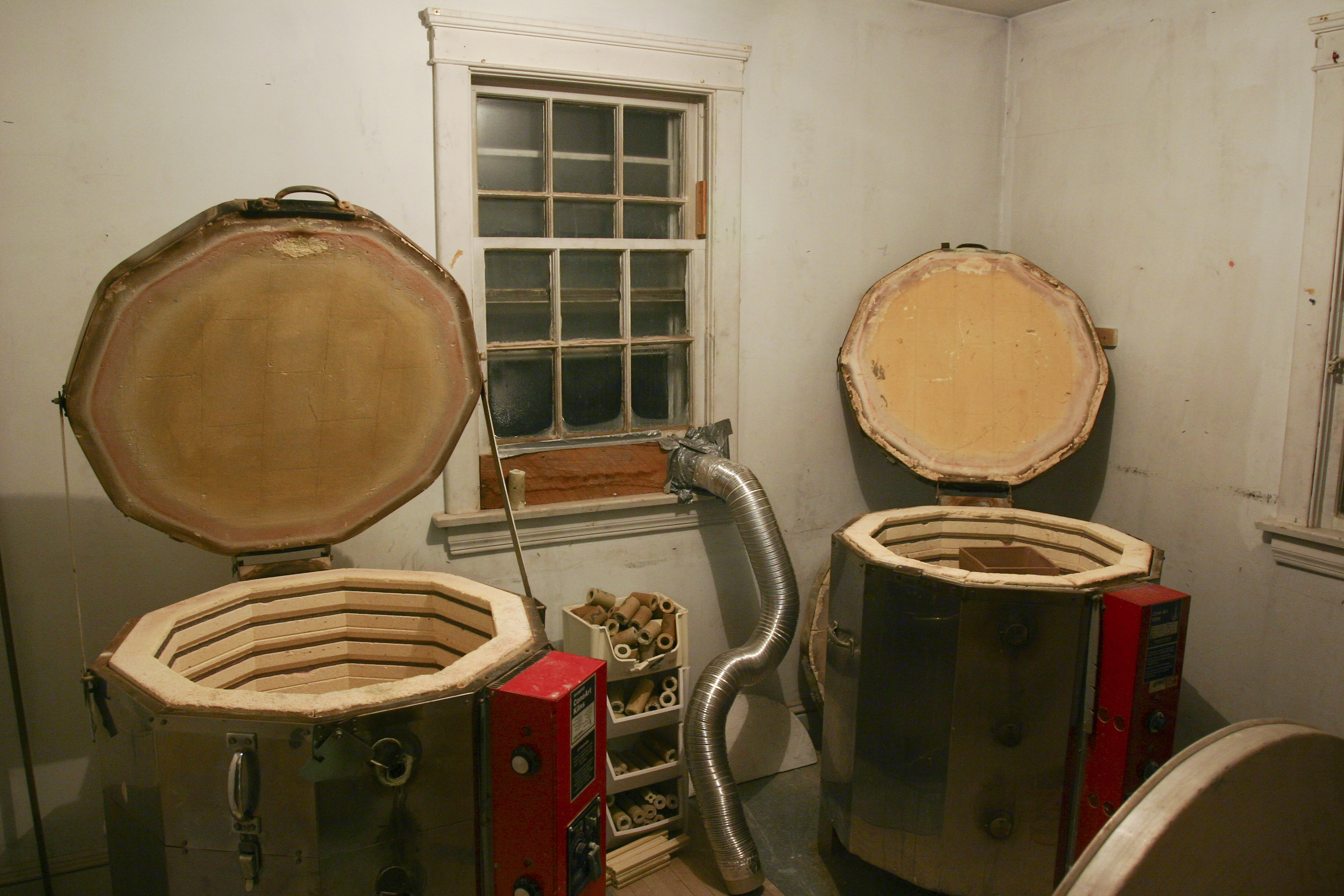
The L&L EnviroVent uses the same downdraft principle as the Vent-Sure and is designed for L&L kilns including the e23T. The e23T includes a dedicated vent port in the floor casting that the EnviroVent connects to directly, eliminating the need for retrofitting. The motor, duct, and exterior termination work identically to the Skutt approach.
L&L’s 3-zone control on the e23T means all three zones fire more evenly than single-zone kilns. The EnviroVent works with this by creating consistent downward airflow, which reinforces the top-to-bottom temperature uniformity the 3-zone system provides.
Room ventilation: when it works and when it does not
For kilns without a downdraft system, room ventilation moves fumes out of the studio by exchanging air. This requires:
- An air source entering the room: a window on one side of the room, slightly open.
- An exhaust path moving fumes to the exterior: a window on the opposite side, a window fan set to exhaust, or a wall-mounted exhaust fan.
- Airflow past the kiln: the inlet and outlet should create a path of air movement that crosses the kiln location, not a short circuit that bypasses it.
Room ventilation works best in a detached garage with large door openings and a window. It is harder to achieve reliably in a basement or interior room. The fan must run continuously throughout the firing, not just while fumes are visible.
What room ventilation does not do well:
- It does not draw fumes downward through the kiln. A downdraft system captures fumes as they form inside the kiln; room ventilation captures them after they escape into the room. For enclosed or sensitive spaces, downdraft is the more effective system.
- It requires the exhaust path to remain open and unobstructed for hours. In a garage, the door must stay open; in cold weather that is uncomfortable and may affect the kiln’s ability to reach temperature by increasing ambient heat loss.
- It does not address the first 30 to 60 minutes of wax resist combustion as effectively as a duct system that routes fumes away from the studio at the source.
Garage vs. basement setup
Garage: A detached garage is the best home studio location for kiln ventilation. With the kiln positioned near the door end and the door open or cracked, cross-ventilation is achievable with a single box fan. A Vent-Sure or EnviroVent on the kiln is still recommended, but a garage with good door and window ventilation meets minimum requirements. An attached garage is adequate but shares air with the house through gaps; closing the door between the garage and the house during firings is important.
Basement: Don’t fire a kiln in a basement with no ventilation plan in place. An attached basement often shares air with the living quarters above through gaps around doors, framing, and stairwells, even when it isn’t tied into the house’s HVAC system, so fumes that build up downstairs don’t necessarily stay downstairs. A basement also requires more deliberate planning than a garage: natural ventilation is limited, and most basements lack cross-ventilation opportunities. The effective options are:
- A downdraft ventilation system (Vent-Sure or EnviroVent) with the duct run up through a wall or rim joist to the exterior
- A dedicated exhaust fan on the wall or ceiling, running continuously during the firing
- A window AC unit set to exhaust-only mode, with outside air makeup
Basement kilns in spaces that share HVAC with the house are the highest-concern scenario. If the HVAC system recirculates basement air into living areas, any fume in the basement will reach those areas. A downdraft system with an outdoor duct termination is the recommended approach for this situation.
Planning the duct run
A Vent-Sure or EnviroVent duct run should be:
- As short as possible. Longer duct runs reduce airflow. Manufacturers typically specify a maximum duct length; check the product spec for your system.
- Terminated outside the building. Never terminate into a crawl space, attic, or interior wall. The duct must exit to open air.
- Not shared with HVAC ducts. The fumes carried by the kiln vent duct should not intermix with house HVAC air.
- Fitted with a back-draft damper at the exterior termination to prevent cold air from entering when the vent is off.
A standard 4-inch dryer vent cap works as the exterior termination and includes a damper. The transition from flexible aluminum duct to rigid duct (where the run goes through a wall) should use approved metal ducting and be sealed at all joints.

Carbon monoxide monitoring
A CO detector is worth adding to any home kiln studio. Standard residential CO detectors are designed to alert at levels harmful to sleeping adults over extended periods; they are not sensitive enough to detect low-level CO accumulation from ceramic firings. A low-level CO detector with a digital readout shows realtime parts-per-million, which lets you confirm that your ventilation setup is maintaining safe levels.
CO at 35 ppm is the OSHA 8-hour permissible exposure limit. Levels above 200 ppm cause headaches and dizziness. A CO monitor with digital display used during several firings with different ventilation arrangements will tell you whether your current setup is adequate.
For kiln-specific setup and ventilation recommendations alongside each model’s specifications, see the KM-1027 review, KM-1018 review, L&L e23T review, and kiln placement guide. For the full new-buyer decision including studio setup questions, see the first kiln buying guide.