kiln-guides 14 min read
Used Kiln Buying Guide: What to Inspect Before You Pay
How to value and inspect a used electric kiln: the 208-volt trap, element and brick checks, relay and controller costs, and the point where you walk away.

A used electric kiln is worth roughly half of a comparable new one in good condition, and far less than that once elements or wiring are due. Check the voltage on the data tag before anything else, then the elements, the brick, and the relays. A 208-volt kiln fired on a 240-volt house circuit destroys itself.
That is the whole guide in four sentences. The rest of this page is the arithmetic behind it, drawn from what the two largest American kiln makers publish about their own equipment, plus the current parts prices that decide whether a cheap kiln is actually cheap.
What is a used kiln actually worth?
L&L publishes the most honest answer any manufacturer has put in writing. They begin with the obvious: a kiln “is valued at whatever someone is willing to pay for it.” Then they give a ladder. Start at about half the price of the comparable new model. Take another 25 percent off if the wiring needs replacing. Take another 15 percent off if the elements need replacing. If the brick needs extensive repair, the kiln has minimal to no value. They also note the blunt version potters use at estate sales: about a third of the original purchase price.
Applied to Skutt’s own 2026 list prices, that ladder produces real numbers. Skutt’s price list effective 10 January 2026 puts the KM-818 at $2,940, the KM-1018 at $4,175 and the KM-1027 at $5,060, each with the KM electronic controller at 240 volts.
| Condition of the kiln | Share of new list | KM-818 | KM-1018 | KM-1027 |
|---|---|---|---|---|
| Sound case, good brick, clean flexible wiring, newish elements | 50% | $1,470 | $2,088 | $2,530 |
| Same, but the elements are spent | 35% | $1,029 | $1,461 | $1,771 |
| Elements spent and the wiring is brittle | 10% | $294 | $418 | $506 |
| Brick cracked or crumbling through the walls | minimal | walk | walk | walk |
L&L’s published depreciation ladder applied to Skutt’s 2026 manufacturer list prices for the KM electronic controller at 240 volts. Both sources retrieved 1 August 2026. Dealers discount below list, so treat these as an opening position rather than a market quote.
Two things fall out of that table. The first is that a spent set of elements should move the price by a lot more than most sellers expect, because it moves the buyer’s total outlay by a lot. The second is that L&L’s own floor observation, that plenty of used kilns change hands for $200 to $300, lines up with the bottom row. A kiln at that price is not a bargain. It is a kiln that needs everything.
Why the voltage on the data tag decides everything
Read the metal tag before you read the price. Skutt’s own wiring guidance names the exact scenario this guide exists for: “We see this more commonly if someone buys a used kiln from a school and installs it at home.”
Schools and commercial buildings frequently run 208 volts. Houses run 240. The two look identical from across a garage and behave nothing alike.
A 240-volt kiln on a 208-volt supply is merely disappointing. It will reach bisque temperatures at cone 06 and cone 04, slowly, and struggle to make cone 5 through cone 10 at all. Nothing breaks. The kiln just never quite gets there.
A 208-volt kiln on a 240-volt supply is the expensive one. Skutt puts the overage at 15 percent and the consequence plainly: enough “to burn out the elements and damage the relays and even the computer controller.” That is the element set, the relays and the control board, all at once, on the first serious firing.
Skutt’s tolerance is plus or minus 3 percent. A 240-volt kiln wants a supply between 232 and 247 volts. A 208-volt kiln wants 202 to 214. Measuring the actual voltage at the receptacle takes about thirty seconds with a meter, and it is the single highest-value thing you can do before buying.
The fix, if the kiln you want is on the wrong voltage, is usually just elements: Skutt states that “the elements are the only difference between kilns wired for 208 volts and 240 volts.” Two caveats come attached. The maximum firing temperature may drop after a conversion, and a phase mismatch between single-phase and three-phase supply requires other wiring changes. A three-phase kiln out of a school shop is not a home kiln, and no element swap makes it one.
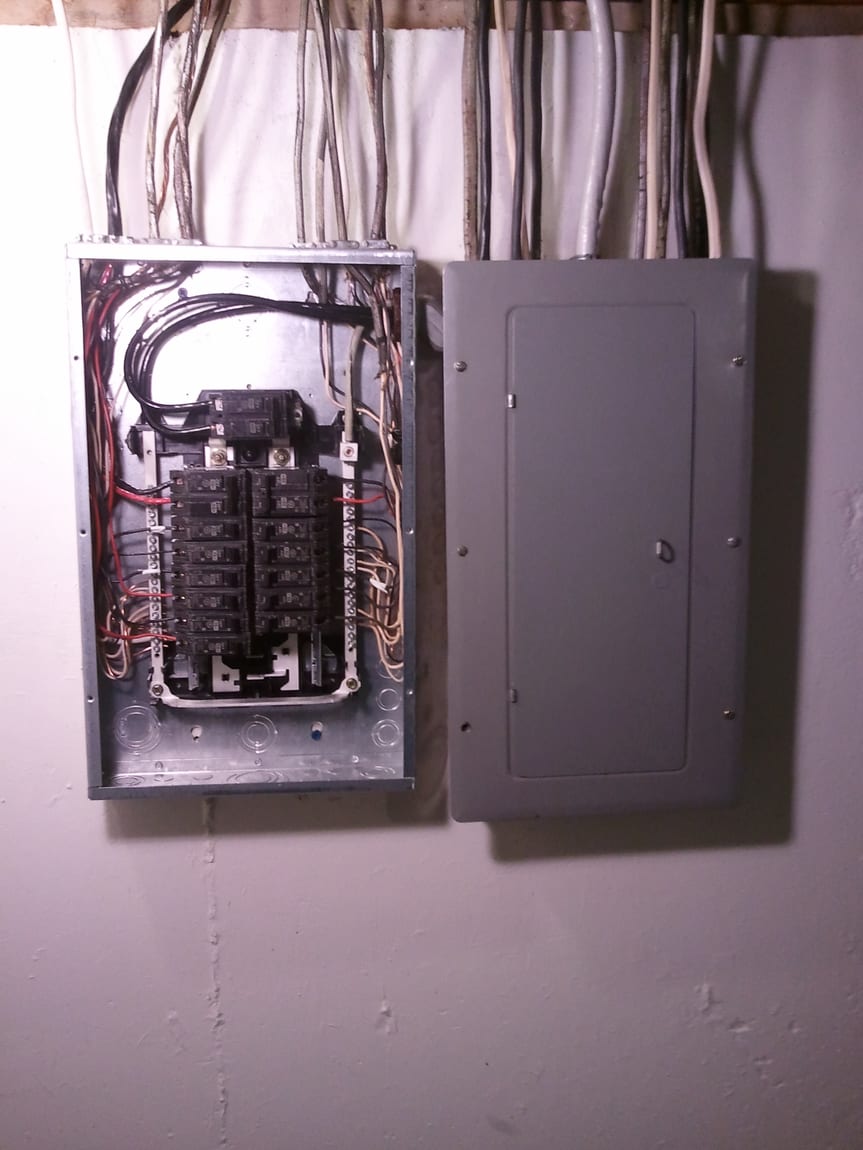
Two more details from Skutt’s installation guidance that matter on a secondhand kiln. Runs longer than 50 feet from the panel want heavier wire, roughly two gauge sizes larger per 50 feet, to avoid a low-voltage condition. And the plug on the end of the kiln’s 6-foot cord should be the original: altering it can void the warranty, and on a used kiln a swapped plug is a sign somebody was making the kiln fit a circuit rather than the other way round. For the full breaker, wire and receptacle table by model, see the kiln electrical requirements guide.
What to inspect, in order
Work top to bottom, and take twenty minutes over it. A seller who will not allow that is telling you something.
Elements. Look down each groove. The coil should sit in its channel evenly, not droop, not bunch, and not touch itself anywhere. L&L’s description of the failure mode is precise: the alloy “becomes very brittle after firing,” the wire grows with use, and resistance climbs with age, which is why an old kiln fires slowly and stalls short of temperature. A drooped element cannot be pushed back cold. It has to be warmed to just under red heat and reformed with needle-nose pliers, and if the groove itself is broken you have likely lost that element. Bring a meter and check resistance element by element; L&L recommends that check every 20 firings on a kiln you own, and it is the closest thing to an odometer a used kiln has.
Brick. Chips at the edges, old glaze runs and a dusty surface are normal. What you are hunting for is a crack that runs through a wall, a groove broken open where the element seats, and a floor slab that has cracked across. Skutt sells brick by the piece, which is the good news: a straight brick for a 10-sided kiln is $17.75 and a peep brick is $18.25 on the 2026 list. The bad news is the big pieces. A 10-sided 2.5-inch lid is $380 and the floor slab is $365. On an 8-sided kiln the same pair runs $255 and $245.
Controller and relays. Power the kiln up. The display should light, the controller should run a program, and you should hear the relays click as they cycle. Relays are consumables: L&L puts them at roughly 200,000 cycles on average, about 18 months of typical use, which their own worked example converts to about 173 firings at a 25-second cycle time. They also note relays “can fail long before or long after without any explanation.” A Skutt 25-amp relay is $43 for the black-case version on newer or upgraded KilnMaster kilns and $52 for the clear-case version used on older ones. The number of relays varies by model and phase, so count them against the parts diagram for the exact kiln in front of you rather than assuming.
Lid, hinge and case. Lift the lid through its full travel. A lid that has to be wrestled has a bent hinge leaf or a tired brace, both cheap: $9.50 for a lid hinge leaf, $12.00 for a body hinge leaf, $13.00 for a strut, $70.00 for the 1018 and 1027 lid brace package. Squeeze the case bands. L&L’s maintenance schedule has owners retightening the stainless case tighteners every 20 firings because the case expands and contracts on every cycle and the brick shrinks slightly with use, most of all at cone 10. A case that has never been tightened is a case whose owner never read the manual, which tells you what else was skipped.
Cord, plug and terminals. Look for scorching at the terminal block, brittle or crumbling wire insulation, and a plug with heat discoloration on the blades. L&L’s 50-firing checklist is to inspect wires for deterioration and terminals for oxidation and replace anything brittle. Discoloration at a connection means heat, and heat at a connection means resistance where there should be none.
What does it cost to bring a tired kiln back?
Every figure below is Skutt’s own list price from the 2026 parts price list, effective 10 January 2026, and the element counts are the quantities Skutt lists as installed in each kiln. This is the number to hold in your head while a seller talks.
| Part (Skutt 2026 list) | KM-818 | KM-1018 | KM-1027 |
|---|---|---|---|
| Full element set, standard | 4 at $63 = $252 | 4 at $74 = $296 | 6 at $74 = $444 |
| Full element set, APM alloy | 4 at $150 = $600 | 4 at $185 = $740 | 6 at $185 = $1,110 |
| Type K thermocouple with block and wire | $45 | $45 | $45 |
| One 25-amp relay, black case | $43 | $43 | $43 |
| Element feeder wire set | $49 | $49 | $67 |
| Control harness wire set | $44 | $44 | $53 |
| Power cord and plug | $175 | $175 | $225 |
| Replacement lid, brick | $255 | $380 | $380 |
| Complete KilnMaster control box | $835 | $835 | $1,025 |
| Standard electrical refresh (elements, thermocouple, one relay, both wire sets) | $433 | $477 | $652 |
| Refresh as a share of new list price | 15% | 11% | 13% |
Part prices and per-kiln element quantities from Skutt’s 2026 parts price list; new-kiln list prices from Skutt’s 2026 kiln price list. Both retrieved 1 August 2026. Dealer prices vary and shipping is extra.
The refresh column is the useful one. Elements, a thermocouple, a relay and fresh wire on a KM-1027 is $652 at manufacturer list. Buy that kiln at the 35 percent row, $1,771, spend the $652, and you are into a fully re-electrified 7-cubic-foot kiln for about $2,423 against $5,060 new. That is a good trade. Do the same arithmetic on a KM-818 bought for $1,029 and you land at $1,462 against $2,940 new, which is a thinner but still real margin.
Where it stops working is the control box. A complete KilnMaster box is $835 on the small kilns and $1,025 on a KM-1027. Add that to a full refresh and a used KM-1027 has to be nearly free to make sense. Two figures worth pairing with these: a type K thermocouple element is only $24 on its own, and L&L recommends changing thermocouples at the same time as elements because type K drifts with age. Doing both at once costs almost nothing extra in labor and removes two variables at the same moment.
Independent dealers price close to Skutt’s list. Ceramic Superstore lists the KM-1027 top and bottom element, part 0171, at $74.00, exactly Skutt’s number. The Potter’s Shop sells Skutt replacement elements at $63.00 each with the porcelain insulators, connectors and pins included in the package, with model, voltage, phase and position selected at order time. That last detail matters: order by model and voltage and phase, not by kiln name alone. For the full replacement procedure and the DIY-versus-technician question, see kiln element replacement.
Can you test fire a kiln before you buy it?
If the kiln is still connected at the seller’s place, yes, and you should. Bring witness cones. Set a self-supporting cone 6 on a shelf, run the kiln’s own cone 6 program, and read the cone rather than the display. A cone that stands nearly straight while the controller reports it hit temperature is telling you the elements are tired, the thermocouple has drifted, or the supply voltage is wrong. All three are things you just learned for the price of a cone.
If a full firing is not practical, run the kiln to about 1,000°F and stand there. Listen for the relays cycling, watch for a section that stays visibly darker than the others through the peepholes, and feel the cord and the receptacle plate for heat. L&L’s 20-firing checklist has owners checking cord and breaker temperature during operation for exactly this reason.
For what the numbers on the cones mean and how to place them, see pyrometric cones explained. For the programs to run during a test, see kiln firing schedules.
When should you walk away?
Five conditions. Any one of them is enough.
- The voltage or phase does not match your supply and cannot be converted. Three-phase is the hard stop. A 208-versus-240 mismatch is an element set, which is survivable; a phase mismatch is not a home project.
- Cracks run through the brick walls or the floor slab is broken across. Brick that has failed structurally takes the lid and the slab with it, and $380 plus $365 on a 10-sided kiln is most of the value of the machine.
- The seller will not let you open the lid, power it up, or see the data tag. There is no version of this that ends well.
- The controller is dead and the kiln is old enough that the box is discontinued. A live control box is $835 to $1,025. A discontinued one is a parts hunt.
- The price is above the 50 percent row and the kiln is not in the condition that row describes. Sellers anchor on what they paid. The ladder above is your counterweight, and it comes from a kiln manufacturer, not from a buyer trying to talk the price down.
There is also a quieter reason to walk: a kiln with no history. L&L’s answer to how long a kiln lasts is not a number but a list of questions, about cone, firing frequency, shelf loading, venting, vacuuming and case tightening, and only then, for anyone who insists on a figure, “a nice safe middle number is about 10 years.” Ten years of careful cone 6 work and ten years of hard cone 10 school use are not the same kiln, and only the seller’s records can tell you which one is in front of you.
Where used beats new, and where it does not
Used wins on the parts that do not wear: the steel case, the stand, the brick when it has been looked after, the hinge and the bands. Those are the expensive-to-manufacture pieces, and they are exactly what a careful owner hands over intact. Used also wins on the accessories that come along for free. A used kiln bought from a working potter usually arrives with shelves and posts, and Skutt’s furniture kit for a KM-1027 lists at $775 on its own.
New wins on everything that wears. Fresh elements with a known firing count, a thermocouple that has not drifted, a warranty, and a controller with current firmware. That is worth real money on a first kiln, when you do not yet know what a worn element looks like. If this is your first kiln, read the first kiln buying guide before you shop the used market at all, and price the model you actually want new before you decide what a used one is worth.
The honest summary is that the used market rewards people who can read a kiln. If you can check resistance across six elements, spot a broken groove, and measure the voltage at the receptacle, a used KM-1027 at $1,771 with $652 of parts in it is one of the best deals in the craft. If you cannot yet do those things, the discount is not a discount. It is a bill arriving later.
For what the kiln costs to run once it is yours, see kiln cost to fire. For where it can safely sit and how to vent it, see the kiln ventilation guide. For what every replaceable part costs and how long it lasts, see the kiln parts guide.
What to bring to the inspection
A meter, cones, a flashlight, and a tape measure for the doorway the kiln has to come through. As an Amazon Associate we earn from qualifying purchases.
- Klein Tools MM420 digital multimeter for element resistance and for measuring the actual voltage at the receptacle.
- Self-supporting cone 6 witness cones and cone 04 witness cones for a test fire that reports the truth.
- Kiln wash for the shelves that come with the kiln, which will need it.
- Kiln shelves and posts if the seller keeps theirs, which happens more often than you would think.